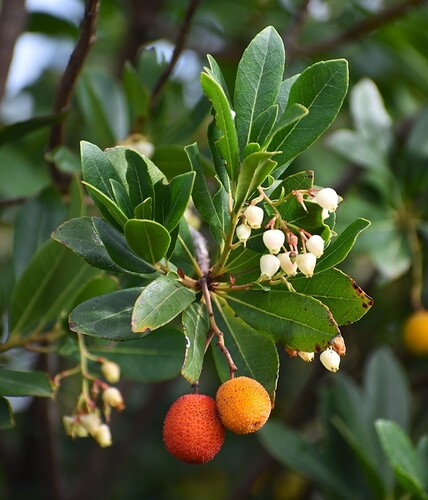
Arbutus unedo
Strawberry tree · also Madrone, Irish strawberry tree, Cain
Report an issue with this species
Arbutus unedo, also known as strawberry tree or madrone, is an evergreen shrub or small multi-trunked tree native to the Mediterranean Basin and Western Europe. It is valued for its attractive shiny dark green foliage, interesting bark, showy white flowers, and red, strawberry-like fruits that attract birds. This durable species is resistant to oak root fungus, but its fruit can be messy near walkways, requiring some light trimming to manage height.
Where it grows
Trees in each city's inventory, with the share of that city's named trees this species accounts for.
- 4740.35%—7.0 in
- 2780.02%—1.9 in
- 1820.04%35 yr7.5 in
- 1420.06%——
- 1030.04%—2.5 in
- 700.05%—1.9 in
- 450.03%—8.0 in
- 120.03%—7.9 in
- 30.00%——
Traits
- Form
- Multi-trunk
- Foliage
- Evergreen
- Mature height
- 20–35 ft
- Canopy spread
- 20–35 ft
- Drought tolerance
- Moderate
- Wildlife value
- Moderate
- Blooms
- Jan, Feb, Sep, Oct, Nov, Dec
Trunk diameters across every city: median 5.0 in, mean 6.3 in, 90th percentile 13 in. Measured at breast height, as published by each inventory.
Native range
Terrestrial ecoregions where this species is native. Trees in the dataset mostly stand well outside it.
Mediterranean Forests, Woodlands & Scrub
- Aegean and Western Turkey sclerophyllous and mixed forests
- Cyprus Mediterranean forests
- Northeast Spain and Southern France Mediterranean forests
Other Arbutus in the catalogue
4 of the top 2,000 species are in this genus.


