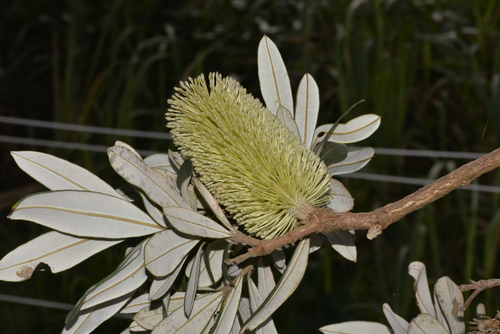
Banksia integrifolia
Coast banksia · also White-honeysuckle, Honeysuckle-oak, White banksia
Report an issue with this species
Banksia integrifolia, commonly known as coast banksia, is a highly variable tree or large shrub reaching up to 25 meters tall, characterized by dark green leaves with white undersides and pale yellow, cylindrical flower spikes. Native to the east coast of Australia, from coastal dunes to mountains, it attracts various insects, birds, and mammals for pollination. This hardy species is a popular choice for urban planting, streetscapes, and dune stabilization due to its adaptability.
Where it grows
Trees in each city's inventory, with the share of that city's named trees this species accounts for.
- 5410.35%—1.9 in
- 180.01%5.6 yr3.0 in
Traits
- Foliage
- Evergreen
- Mature height
- 30–60 ft
- Canopy spread
- 15–30 ft
- Wildlife value
- High
- Blooms
- Apr, May, Jun, Jul, Aug, Sep
Trunk diameters across every city: median 1.9 in, mean 3.0 in, 90th percentile 5.6 in. Measured at breast height, as published by each inventory.
Native range
Terrestrial ecoregions where this species is native. Trees in the dataset mostly stand well outside it.
Temperate Broadleaf & Mixed Forests
- Eastern Australian temperate forests
- Southeast Australia temperate forests
Tropical & Subtropical Moist Broadleaf Forests
- Queensland tropical rain forests
Temperate Grasslands, Savannas & Shrublands
- Southeast Australia temperate savanna
Other Banksia in the catalogue
3 of the top 2,000 species are in this genus.

