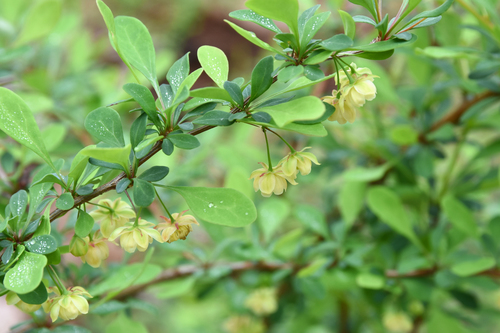
Berberis thunbergii
Japanese barberry · also Thunberg's barberry, Red barberry, Japanese berberis
Report an issue with this species
Berberis thunbergii is a small, deciduous shrub with green leaves that turn red in autumn, producing brilliant red fruits in autumn and pale yellow flowers in spring. Native to Japan and eastern Asia, it is a problematic invasive in many regions, causing declines in species diversity, increased tick habitat, and soil changes.
Where it grows
Trees in each city's inventory, with the share of that city's named trees this species accounts for.
- 100.01%—4.0 in
- 60.01%23 yr—
- 10.00%—1.6 in
Traits
- Form
- Spreading
- Foliage
- Deciduous
- Mature height
- 3.3 ft
- Canopy spread
- 8.2 ft
- Wildlife value
- Low
- Blooms
- Mar, Apr, May
Trunk diameters across every city: median 4.0 in, mean 3.4 in, 90th percentile 4.0 in. Measured at breast height, as published by each inventory.
Native range
Terrestrial ecoregions where this species is native. Trees in the dataset mostly stand well outside it.
Temperate Broadleaf & Mixed Forests
- Hokkaido deciduous forests
- Nihonkai montane deciduous forests
- Taiheiyo montane deciduous forests
Other Berberis in the catalogue
3 of the top 2,000 species are in this genus.

