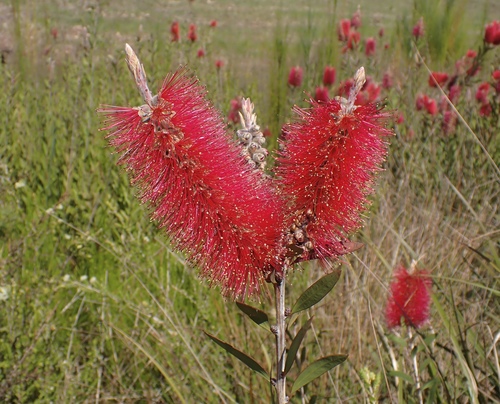
Callistemon lanceolatus
Common red bottlebrush · also Crimson bottlebrush, Lemon bottlebrush, Bottle brush tree
Report an issue with this species
This hardy and adaptable evergreen species, often grown as a shrub or small tree, is popular for its showy red bottlebrush-like flowers that can be present for most of the year. Its leaves release a lemon scent when crushed, contributing to its common name.
Where it grows
Trees in each city's inventory, with the share of that city's named trees this species accounts for.
- 2,8510.61%29 yr9.0 in
Traits
- Foliage
- Evergreen
- Mature height
- 20–25 ft
- Canopy spread
- 25 ft
- Water needs
- Low
- Drought tolerance
- High
- Wildlife value
- Moderate
- Blooms
- Mar, Apr, May, Jun, Jul, Aug
Trunk diameters across every city: median 9.0 in, mean 7.7 in, 90th percentile 9.0 in. Measured at breast height, as published by each inventory.
Native range
Terrestrial ecoregions where this species is native. Trees in the dataset mostly stand well outside it.
Temperate Broadleaf & Mixed Forests
- Eastern Australian temperate forests
- Southeast Australia temperate forests
Temperate Grasslands, Savannas & Shrublands
- Eastern Australia mulga shrublands
- Southeast Australia temperate savanna
Tropical & Subtropical Moist Broadleaf Forests
- Queensland tropical rain forests
Other Callistemon in the catalogue
7 of the top 2,000 species are in this genus.


