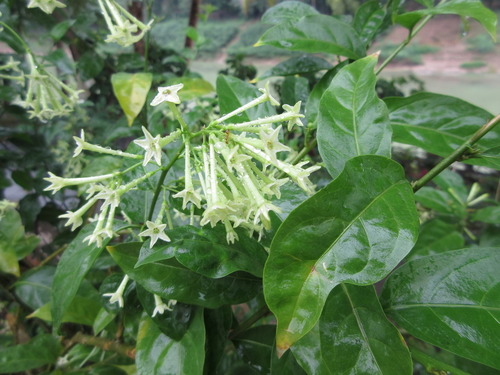
Cestrum nocturnum
Lady of the night · also Night-blooming jasmine, Night-blooming jessamine, Night-scented jessamine
Report an issue with this species
Cestrum nocturnum is an erect, drooping, or spreading shrub to small tree, growing up to 4 meters tall, with greenish-grey leaves and fragrant yellow to greenish-white flowers that produce white fruits. Native to Mexico, Central America, and northern South America, its nocturnal scent attracts night-flying insect pollinators in wet tropical climates. Widely cultivated as an ornamental or for hedging, this plant is notable for its strong night-time fragrance but has been implicated in animal poisoning.
Where it grows
Trees in each city's inventory, with the share of that city's named trees this species accounts for.
- 20,3021.4%——
- 310.01%—7.5 in
- 10.00%—2.9 in
No city in this list records planting dates for this species, so age is blank throughout.
Traits
- Foliage
- Evergreen
- Mature height
- 3.3–13.1 ft
- Water needs
- Moderate
- Wildlife value
- Moderate
Trunk diameters across every city: median 6.9 in, mean 8.0 in, 90th percentile 16 in. Measured at breast height, as published by each inventory.
Native range
Terrestrial ecoregions where this species is native. Trees in the dataset mostly stand well outside it.
Tropical & Subtropical Moist Broadleaf Forests
- Central American Atlantic moist forests
- Central American montane forests
- Northwest Andean montane forests
- Southwest Amazon moist forests
Tropical & Subtropical Dry Broadleaf Forests
- Central American dry forests
Tropical & Subtropical Coniferous Forests
- Central American pine-oak forests
Other Cestrum in the catalogue
3 of the top 2,000 species are in this genus.