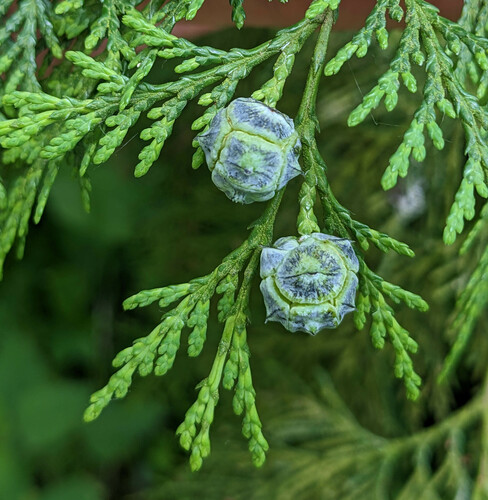
Chamaecyparis lawsoniana
Port Orford cedar · also Lawson's cypress, Ginger pine, Lawson false cypress
Report an issue with this species
Chamaecyparis lawsoniana, also known as Port Orford cedar, is a long-lived conifer native to Oregon and northwestern California, found in the Klamath Mountains. It is characterized by thick, soft, light brown bark, immense tapering trunks, and lacy foliage with bluish-gray cones. It often co-occurs with other conifers in mixed forests.
Where it grows
Trees in each city's inventory, with the share of that city's named trees this species accounts for.
- 8,5320.75%—2.8 in
- 6540.36%—21 in
- 6400.04%——
- 5470.24%—8.8 in
- 2230.08%47 yr5.9 in
- 1100.31%—17 in
- 760.02%32 yr9.1 in
- 350.22%—20 in
- 220.01%—3.8 in
- 220.04%——
- 90.01%23 yr22 in
- 70.00%—3.0 in
- 50.00%—5.0 in
- 50.00%—3.9 in
- 50.00%35 yr7.5 in
Traits
- Form
- Conifer
- Foliage
- Evergreen
- Mature height
- 50–100 ft
- Canopy spread
- 15–20 ft
- Growth rate
- Moderate
- Wildlife value
- Moderate
- Blooms
- Mar, Apr, May
Trunk diameters across every city: median 3.3 in, mean 5.8 in, 90th percentile 14 in. Measured at breast height, as published by each inventory.
Native range
Terrestrial ecoregions where this species is native. Trees in the dataset mostly stand well outside it.
Temperate Conifer Forests
- Klamath-Siskiyou forests
- Northern California coastal forests
Other Chamaecyparis in the catalogue
6 of the top 2,000 species are in this genus.


