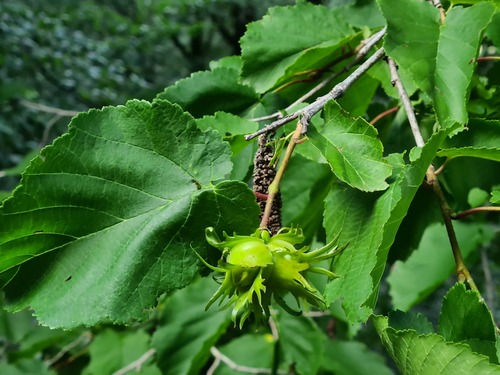
Corylus colurna
Turkish hazel · also Byzantine filbert, Constantinople-nut, Clusternut
Report an issue with this species
Corylus colurna, also known as Turkish hazel, is an attractive deciduous tree with a pyramidal growth habit. Native to southeastern Europe and western Asia, it is very cold-hardy and features bright green leaves that turn yellow in fall. Its corky bark provides visual interest, and while it produces edible nuts, they are primarily valued by wildlife like squirrels.
Where it grows
Trees in each city's inventory, with the share of that city's named trees this species accounts for.
- 8,4261.9%34 yr9.1 in
- 5,3610.47%—2.6 in
- 3,4491.5%—9.4 in
- 1,9970.29%—3.1 in
- 1,1840.42%37 yr9.8 in
- 9170.28%8.3 yr2.0 in
- 6820.22%—3.0 in
- 5360.16%6.2 yr2.0 in
- 3480.05%—5.0 in
- 2360.48%12 yr2.8 in
- 1990.27%6.8 yr2.8 in
- 1480.06%—2.0 in
- 1280.29%—2.4 in
- 1100.15%5.8 yr1.6 in
- 920.79%3.3 yr2.0 in
- 720.05%2.9 yr2.0 in
- 630.03%—11 in
- 570.12%—2.4 in
- 330.02%7.4 yr3.5 in
- 220.14%29 yr11 in
- 220.02%5.5 yr2.0 in
- 180.15%—7.5 in
- 80.01%15 yr2.0 in
- 20.00%—4.5 in
- 10.00%—21 in
Traits
- Form
- Conifer
- Foliage
- Deciduous
- Mature height
- 50–75 ft
- Canopy spread
- 30 ft
- Growth rate
- Fast
- Wildlife value
- Moderate
- Blooms
- Jan, Feb, Dec
Trunk diameters across every city: median 6.3 in, mean 6.9 in, 90th percentile 13 in. Measured at breast height, as published by each inventory.
Native range
Terrestrial ecoregions where this species is native. Trees in the dataset mostly stand well outside it.
Temperate Broadleaf & Mixed Forests
- Balkan mixed forests
- Caucasus mixed forests
- Eastern Anatolian deciduous forests
Temperate Conifer Forests
- Elburz Range forest steppe
Mediterranean Forests, Woodlands & Scrub
- Aegean and Western Turkey sclerophyllous and mixed forests
Other Corylus in the catalogue
7 of the top 2,000 species are in this genus.


