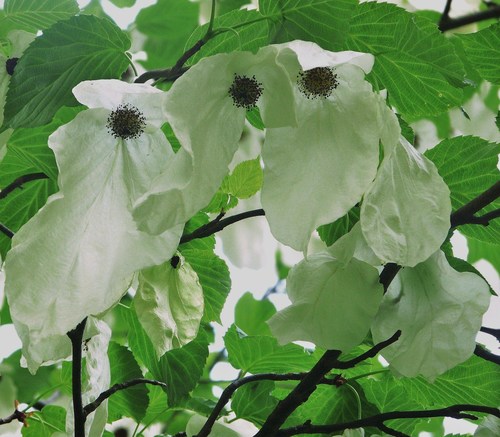
Davidia involucrata
Dove tree · also Ghost tree, Handkerchief tree, Pocket handkerchief tree
Report an issue with this species
Davidia involucrata, also known as the handkerchief or dove tree, is a medium-sized deciduous tree with distinctive broad, heart-shaped foliage that turns bronze, orange, and red in fall. It is renowned for its showy white bracts in late spring that resemble doves or handkerchiefs fluttering in the breeze. Native to central and southern China, it prefers sheltered environments like montane mixed forests and is valued as an ornamental in parks and gardens, though its flower buds can be susceptible to late frosts.
Where it grows
Trees in each city's inventory, with the share of that city's named trees this species accounts for.
- 2200.12%—6.0 in
- 1530.01%—0.9 in
- 550.02%18 yr9.8 in
- 370.02%—3.4 in
- 140.09%—8.7 in
- 90.03%—6.3 in
- 70.00%2.8 yr2.4 in
- 60.01%15 yr17 in
- 30.00%—7.3 in
- 10.00%——
Traits
- Form
- Broadleaf
- Foliage
- Deciduous
- Mature height
- 35–70 ft
- Canopy spread
- 15–40 ft
- Soil
- Sandy, Well-drained
- Water needs
- Moderate
- Drought tolerance
- Low
- Wildlife value
- Moderate
- Fire risk
- Low
- Blooms
- May
Trunk diameters across every city: median 4.5 in, mean 5.6 in, 90th percentile 11 in. Measured at breast height, as published by each inventory.
Native range
Terrestrial ecoregions where this species is native. Trees in the dataset mostly stand well outside it.
Temperate Broadleaf & Mixed Forests
- Central China Loess Plateau mixed forests
Other Davidia in the catalogue
2 of the top 2,000 species are in this genus.