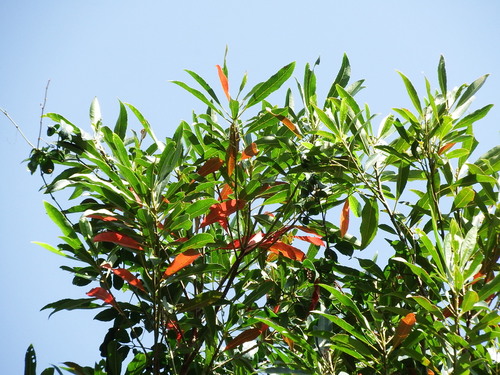
Elaeocarpus decipiens
Japanese blueberry tree · also Shan du ying, Woodland elaeocarpus
Report an issue with this species
The Japanese blueberry tree (Elaeocarpus decipiens) is an evergreen flowering tree with a rounded crown and neat, upright trunk, featuring dense, glossy foliage and new growth that emerges vibrant red. Its small, white to creamy yellow flowers develop into black, olive-like drupes. This adaptable species is suitable for urban planting due to its modest size and ornamental appeal.
Where it grows
Trees in each city's inventory, with the share of that city's named trees this species accounts for.
- 2,6381.2%—5.5 in
- 710.05%—3.0 in
- 20.01%—15 in
No city in this list records planting dates for this species, so age is blank throughout.
Traits
- Form
- Broadleaf
- Foliage
- Evergreen
- Mature height
- 40–60 ft
- Canopy spread
- 20–30 ft
- Growth rate
- Fast
- Water needs
- Low
- Drought tolerance
- Low
- Wildlife value
- Moderate
- Blooms
- Jun, Jul, Aug, Sep, Oct, Nov
Trunk diameters across every city: median 5.5 in, mean 5.5 in, 90th percentile 7.9 in. Measured at breast height, as published by each inventory.
Native range
Terrestrial ecoregions where this species is native. Trees in the dataset mostly stand well outside it.
Tropical & Subtropical Moist Broadleaf Forests
- Nansei Islands subtropical evergreen forests
- Northern Vietnam lowland rain forests
- South China-Vietnam subtropical evergreen forests
- Taiwan subtropical evergreen forests
Other Elaeocarpus in the catalogue
5 of the top 2,000 species are in this genus.
