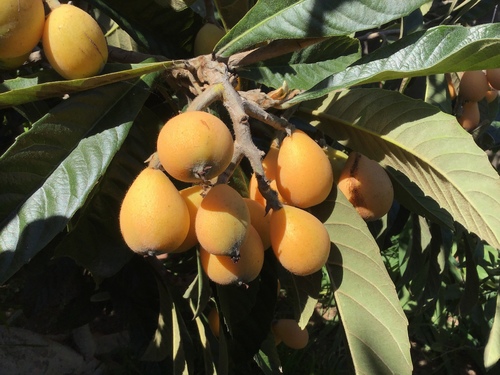
Eriobotrya
Report an issueBy recorded trees in the inventory · identified to genus only.
Bronze loquat · also Coppertone loquat, Loquat
Eriobotrya species are evergreen shrubs or small trees in the Rosaceae family, known for their attractive foliage that can be bronzy-green or copper-colored when new. They produce showy flowers in spring to early summer and require consistent moisture, as they are not drought tolerant.
Species colors
- Foliage
- #4c4e2c
Traits
- Form & size
- Mature height15–25 ftCanopy spread15–25 ft
- Evergreen foliage
- Blooms
- Mar, Apr, May, Jun
- Fast growth rate
- Sun
- Full sun, Part shade
- Soil
- Well-drained
- Moderate water needs
- Low drought tolerance
- High wildlife value
Size sketches use the middle of each recorded range (or the available bound), beside a 6 ft person. Missing dimensions are illustrative.
Trunk diameters across every city: median 4.0 in, mean 4.7 in, 90th percentile 9.7 in. Measured at breast height, as published by each inventory.
Where it grows
Cities that list the tree in their inventory, and what % of their named trees it represents.
- 280.01%—2.9 in
- 260.04%—5.8 in
- 20.00%—2.9 in
- 20.00%—6.4 in
- 10.00%——
- 10.00%—7.0 in
- 10.00%——
- 10.00%——
- 10.00%——
No city in this list records planting dates for this species, so age is blank throughout.
Native range
Ecoregions where the species is native.
Tropical & Subtropical Moist Broadleaf Forests
- South China-Vietnam subtropical evergreen forests
- Taiwan subtropical evergreen forests
Tropical & Subtropical Dry Broadleaf Forests
- Southern Vietnam lowland dry forests
Other Eriobotrya in the catalogue
3 of the top 2,000 species are in this genus.

