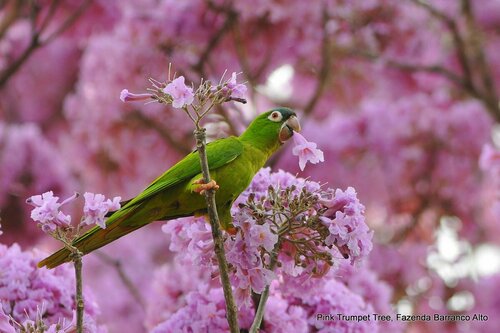
Handroanthus impetiginosus
Pink ipê · also Pink lapacho, Pink trumpet tree, Macuelizo enano
Report an issue with this species
This tree is known for its stunning display of vibrant pink to purple flowers that bloom in clusters. It typically has a straight trunk with grayish bark and provides moderate shade. Once established, it is relatively drought-tolerant, making it suitable for urban environments.
Where it grows
Trees in each city's inventory, with the share of that city's named trees this species accounts for.
- 1,3240.38%—3.9 in
- 5290.33%—3.1 in
- 920.02%36 yr1.5 in
Traits
- Form
- Ornamental
- Foliage
- Deciduous
- Mature height
- 20–30 ft
- Canopy spread
- 15–25 ft
- Water needs
- Moderate
- Drought tolerance
- Moderate
- Wildlife value
- Moderate
- Blooms
- Jan, Feb, Mar, Apr, May, Dec
Trunk diameters across every city: median 3.5 in, mean 5.0 in, 90th percentile 11 in. Measured at breast height, as published by each inventory.
Native range
Terrestrial ecoregions where this species is native. Trees in the dataset mostly stand well outside it.
Tropical & Subtropical Moist Broadleaf Forests
- Central American Atlantic moist forests
- Central American montane forests
- Costa Rican seasonal moist forests
- Northwest Andean montane forests
- Southern Andean Yungas
- Southwest Amazon moist forests
Other Handroanthus in the catalogue
6 of the top 2,000 species are in this genus.


