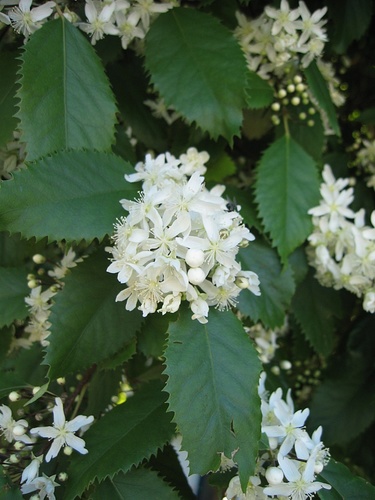
Hoheria
Report an issueBy recorded trees in the inventory · identified to genus only.
Lacebark · also Ribbonwood, Houhere
A genus of small trees and large shrubs endemic to New Zealand, valued for their masses of fragrant white flowers and characteristic lace-like fibrous inner bark. Most species are evergreen, though some mountain species are deciduous, and they generally grow rapidly in sunny, well-drained positions. They are highly attractive to butterflies and other insect pollinators.
Species colors
- Trunk
- #7d7568
- Foliage
- #3c5e32
Traits
- Form & size
- FormOrnamentalMature height20–50 ftCanopy spread25 ft
- Blooms
- Jun, Jul, Aug, Sep, Oct, Nov
- Fast growth rate
- USDA zones
- 8–10
- Sun
- Full sun, Part shade
- Soil
- Well-drained, Clay-tolerant
- Moderate water needs
- Moderate drought tolerance
- High wildlife value
Size sketches use the middle of each recorded range (or the available bound), beside a 6 ft person. Missing dimensions are illustrative.
Trunk diameters across every city: median 5.9 in, mean 7.2 in, 90th percentile 16 in. Measured at breast height, as published by each inventory.
Where it grows
Cities that list the tree in their inventory, and what % of their named trees it represents.
Native range
Ecoregions where the species is native.
Temperate Broadleaf & Mixed Forests
- New Zealand North Island temperate forests
- New Zealand South Island temperate forests
Other Hoheria in the catalogue
4 of the top 2,000 species are in this genus.


