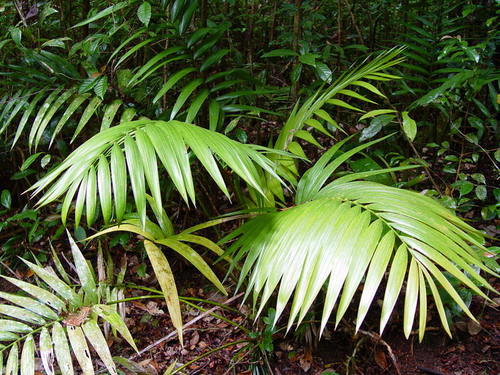
Howea forsteriana
Kentia palm · also Thatch palm, Palm court palm, Kencia
Report an issue with this species
The Kentia palm is a relatively slow-growing, elegant palm known for its feathery canopy. Endemic to Lord Howe Island, it is popular for its ease of maintenance as an indoor and outdoor plant. It tolerates cold temperatures and alkaline soils, but overwatering or over-exposure to direct sunlight can cause foliage issues.
Where it grows
Trees in each city's inventory, with the share of that city's named trees this species accounts for.
- 290.00%——
- 130.01%—5.0 in
- 90.00%—2.0 in
- 60.00%28 yr1.5 in
Traits
- Form
- Palm
- Foliage
- Evergreen
- Mature height
- 15–33 ft
- Canopy spread
- 10–20 ft
- Growth rate
- Moderate
- Soil
- Alkaline
- Water needs
- Moderate
- Blooms
- Jan, Feb, Mar, Apr, May, Jun, Jul, Aug, Sep, Oct, Nov, Dec
Trunk diameters across every city: median 4.2 in, mean 4.2 in, 90th percentile 8.1 in. Measured at breast height, as published by each inventory.
Native range
Terrestrial ecoregions where this species is native. Trees in the dataset mostly stand well outside it.
Tropical & Subtropical Moist Broadleaf Forests
- Lord Howe Island subtropical forests
- Norfolk Island subtropical forests
Other Howea in the catalogue
2 of the top 2,000 species are in this genus.
