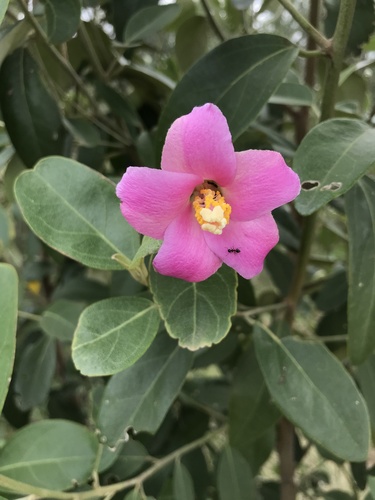
Lagunaria patersonia
Norfolk Island hibiscus · also Pyramid tree, Queensland white oak, Sally wood
Report an issue with this species
This evergreen tree features striking, bell-shaped pink to mauve flowers that fade to white. It has a dense, rounded canopy and smooth, gray bark. It is well-suited for urban and seaside conditions due to its high tolerance for salt and wind, and it attracts pollinators.
Where it grows
Trees in each city's inventory, with the share of that city's named trees this species accounts for.
- 1,5831.0%—5.6 in
- 1,0110.76%9.5 yr3.0 in
- 670.01%35 yr9.0 in
Traits
- Foliage
- Evergreen
- Mature height
- 50 ft
- Canopy spread
- 20 ft
- Water needs
- Moderate
- Wildlife value
- Moderate
- Tolerates
- coastal, salt
- Blooms
- Jun, Jul, Aug, Sep, Oct, Nov
Trunk diameters across every city: median 5.0 in, mean 5.1 in, 90th percentile 7.5 in. Measured at breast height, as published by each inventory.
Native range
Terrestrial ecoregions where this species is native. Trees in the dataset mostly stand well outside it.
Tropical & Subtropical Moist Broadleaf Forests
- Lord Howe Island subtropical forests
- Norfolk Island subtropical forests
- Queensland tropical rain forests
Other Lagunaria in the catalogue
2 of the top 2,000 species are in this genus.
