Livistona
Livistona · also Australian cabbage palm, Chinese fan palm, Fan palm
Report an issue with this species
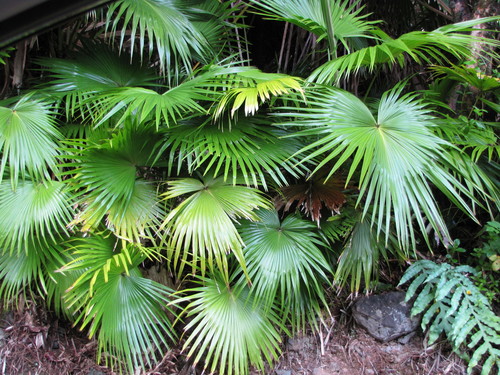
Livistona are fan palms native to Asia, Australasia, and the Horn of Africa, characterized by armed petioles and a crown of fan-shaped leaves. They are generally slow-growing and can be resilient to heat and fire, with some species tolerating coastal conditions. However, their spiny petioles require careful handling, and some species are known to have invasive root systems.
Where it grows
Trees in each city's inventory, with the share of that city's named trees this species accounts for.
- 580.04%3.8 yr12 in
- 50.00%29 yr21 in
Traits
- Form
- Palm
- Foliage
- Evergreen
- Mature height
- 30–50 ft
- Canopy spread
- 15 ft
- Growth rate
- Slow
- Water needs
- Moderate
- Roots
- Invasive
- Wildlife value
- High
- Fire risk
- Low
- Tolerates
- coastal, salt
- Blooms
- Jan, Feb, Mar, Apr, May, Jun, Jul, Aug, Sep, Oct, Nov, Dec
Trunk diameters across every city: median 12 in, mean 13 in, 90th percentile 21 in. Measured at breast height, as published by each inventory.
Native range
Terrestrial ecoregions where this species is native. Trees in the dataset mostly stand well outside it.
Tropical & Subtropical Moist Broadleaf Forests
- Queensland tropical rain forests
- Southern New Guinea freshwater swamp forests
- Southern New Guinea lowland rain forests
- South China-Vietnam subtropical evergreen forests
- South Taiwan monsoon rain forests
- Taiwan subtropical evergreen forests
Tropical & Subtropical Grasslands, Savannas & Shrublands
- Horn of Africa xeric bushlands
- Cape York Peninsula tropical savanna
Temperate Broadleaf & Mixed Forests
- Southeast Australia temperate forests
Other Livistona in the catalogue
2 of the top 2,000 species are in this genus.
