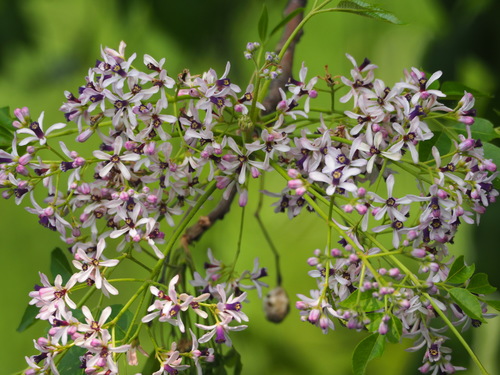
Melia azedarach
Chinaberry tree · also Pride of India, Bead-tree, Cape lilac
Report an issue with this species
Melia azedarach is a medium-sized, rapidly growing, deciduous tree with a spreading canopy and dark green, feathery leaves. It produces clusters of fragrant, lilac flowers in spring and summer, followed by yellowish fruits that persist into winter. This hardy tree tolerates a variety of soil conditions, making it suitable for urban landscapes, and provides habitat and food for wildlife.
Where it grows
Trees in each city's inventory, with the share of that city's named trees this species accounts for.
- 14,2764.1%—22 in
- 2,4351.5%—4.7 in
- 1,2150.79%—3.8 in
- 8570.18%36 yr9.0 in
- 1960.09%—8.3 in
- 180.22%——
- 180.07%—16 in
- 140.01%—13 in
- 30.00%—13 in
Traits
- Form
- Spreading
- Foliage
- Deciduous
- Mature height
- 30–50 ft
- Canopy spread
- 15–25 ft
- Growth rate
- Fast
- Soil
- Well-drained
- Water needs
- Low
- Drought tolerance
- High
- Pollution tolerance
- Moderate
- Wildlife value
- High
- Blooms
- Mar, Apr, May, Jun, Jul, Aug
Trunk diameters across every city: median 20 in, mean 18 in, 90th percentile 30 in. Measured at breast height, as published by each inventory.
Native range
Terrestrial ecoregions where this species is native. Trees in the dataset mostly stand well outside it.
Tropical & Subtropical Moist Broadleaf Forests
- Central Range Papuan montane rain forests
- Northern New Guinea lowland rain and freshwater swamp forests
- Northern New Guinea montane rain forests
- Queensland tropical rain forests
- Southern New Guinea freshwater swamp forests
- Southern New Guinea lowland rain forests
- East Deccan moist deciduous forests
- Hainan Island monsoon rain forests
- Myanmar coastal rain forests
- Northern Khorat Plateau moist deciduous forests
- Northern Thailand-Laos moist deciduous forests
- South China Sea Islands
- South China-Vietnam subtropical evergreen forests
Tropical & Subtropical Dry Broadleaf Forests
- Lesser Sundas deciduous forests
- Sumba deciduous forests
- Timor and Wetar deciduous forests
- Central Deccan Plateau dry deciduous forests
- Central Indochina dry forests
- East Deccan dry-evergreen forests
- North Deccan dry deciduous forests
- South Deccan Plateau dry deciduous forests
- Southeast Indochina dry evergreen forests
Mangroves
- New Guinea mangroves
Tropical & Subtropical Coniferous Forests
- Northeast India-Myanmar pine forests
Temperate Broadleaf & Mixed Forests
- Central China Loess Plateau mixed forests
Other Melia in the catalogue
2 of the top 2,000 species are in this genus.
