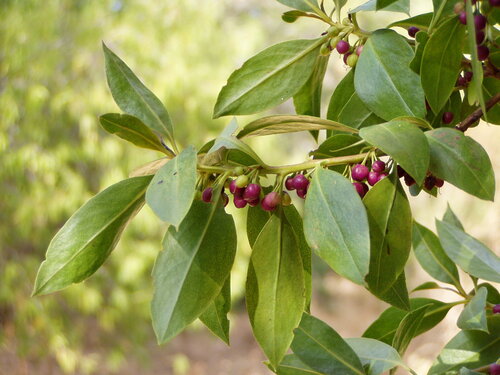
Myoporum
Myoporum · also Ngaio, New Zealand manatoka, Ngaio tree
Report an issue with this species
Myoporum species are typically small trees or shrubs with alternate leaves, white to pink flowers, and drupe fruits. Native to Australia and New Zealand, they thrive in coastal environments. While valued ornamentally, some species like M. laetum are invasive in certain regions due to rapid spread by bird-dispersed, palatable (but toxic) fruits, and are susceptible to pests like the Myoporum thrip.
Where it grows
Trees in each city's inventory, with the share of that city's named trees this species accounts for.
- 4850.32%8.8 yr20 in
Traits
- Foliage
- Evergreen
- Mature height
- 15–30 ft
- Canopy spread
- 10–20 ft
- Growth rate
- Fast
- Water needs
- Moderate
- Drought tolerance
- Moderate
- Roots
- Invasive
- Wildlife value
- High
- Tolerates
- coastal, salt
- Blooms
- Jan, Feb, Dec
Trunk diameters across every city: median 20 in, mean 13 in, 90th percentile 20 in. Measured at breast height, as published by each inventory.
Native range
Terrestrial ecoregions where this species is native. Trees in the dataset mostly stand well outside it.
Tropical & Subtropical Moist Broadleaf Forests
- Norfolk Island subtropical forests
- Queensland tropical rain forests
Temperate Broadleaf & Mixed Forests
- New Zealand South Island temperate forests
- Southeast Australia temperate forests
Temperate Grasslands, Savannas & Shrublands
- Eastern Australia mulga shrublands
- Southeast Australia temperate savanna
Mediterranean Forests, Woodlands & Scrub
- Southwest Australia savanna
- Southwest Australia woodlands
Tropical & Subtropical Grasslands, Savannas & Shrublands
- Victoria Plains tropical savanna
Other Myoporum in the catalogue
3 of the top 2,000 species are in this genus.

