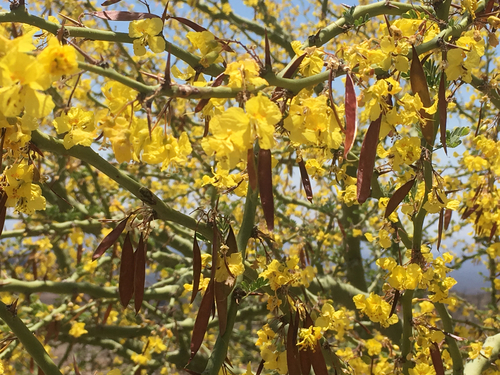
Parkinsonia praecox
Sonoran palo verde · also Palo brea, Palo verde, Foothill palo verde
Report an issue with this species
Parkinsonia praecox, also known as palo brea or Sonoran palo verde, is a small, drought-deciduous tree native to the dry Neotropics. It features a bright green trunk, waxy green bark, and multiple stems with a flat-topped crown. In spring, it produces striking yellow flowers, followed by light brown legume pods. It is well adapted to arid desert environments, requires minimal watering once established, and can hybridize with other Parkinsonia species.
Where it grows
Trees in each city's inventory, with the share of that city's named trees this species accounts for.
- 4851.8%—9.0 in
No city in this list records planting dates for this species, so age is blank throughout.
Traits
- Form
- Spreading
- Mature height
- 20–30 ft
- Canopy spread
- 20 ft
- Growth rate
- Fast
- Water needs
- Low
- Drought tolerance
- High
- Wildlife value
- Moderate
- Blooms
- Mar, Apr, May
Trunk diameters across every city: median 9.0 in, mean 8.8 in, 90th percentile 15 in. Measured at breast height, as published by each inventory.
Native range
Terrestrial ecoregions where this species is native. Trees in the dataset mostly stand well outside it.
Tropical & Subtropical Dry Broadleaf Forests
- Central American dry forests
Other Parkinsonia in the catalogue
5 of the top 2,000 species are in this genus.


