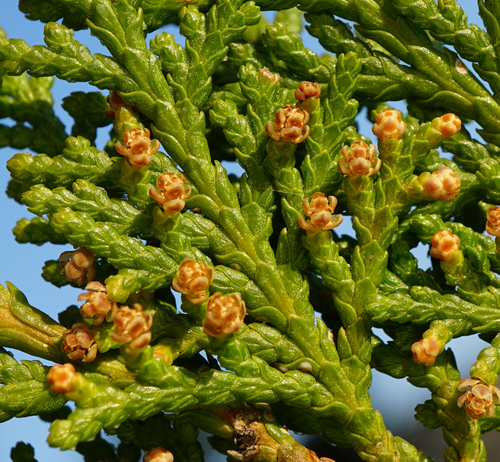
Platycladus orientalis
Chinese thuja · also Oriental arborvitae, Chinese arborvitae, Biota
Report an issue with this species
This evergreen conifer features dark green, scale-like foliage that turns bronze in winter, and reddish, scaly bark. Native to East and North Asia, it tolerates heat, frost, drought, and air pollution, making it suitable for challenging urban environments, though it dislikes strong winds. Its essential oils can cause skin irritation.
Where it grows
Trees in each city's inventory, with the share of that city's named trees this species accounts for.
- 7,1330.49%——
- 5760.12%35 yr7.5 in
- 2620.09%—3.0 in
- 2280.14%—4.5 in
- 690.02%—6.3 in
- 620.03%—13 in
- 600.03%—5.1 in
- 340.13%—18 in
- 160.00%—3.9 in
- 160.01%—5.0 in
- 80.01%—1.9 in
- 70.00%—6.0 in
- 50.00%21 yr12 in
- 50.00%47 yr5.9 in
- 40.01%—7.5 in
Traits
- Form
- Conifer
- Foliage
- Evergreen
- Mature height
- 15–20 ft
- Canopy spread
- 10–15 ft
- Growth rate
- Moderate
- Water needs
- Moderate
- Drought tolerance
- High
- Pollution tolerance
- High
- Wildlife value
- High
- Blooms
- Mar, Apr, May
Trunk diameters across every city: median 7.5 in, mean 7.9 in, 90th percentile 15 in. Measured at breast height, as published by each inventory.
Native range
Terrestrial ecoregions where this species is native. Trees in the dataset mostly stand well outside it.
Temperate Broadleaf & Mixed Forests
- Northeast China Plain deciduous forests
- Southern Korea evergreen forests