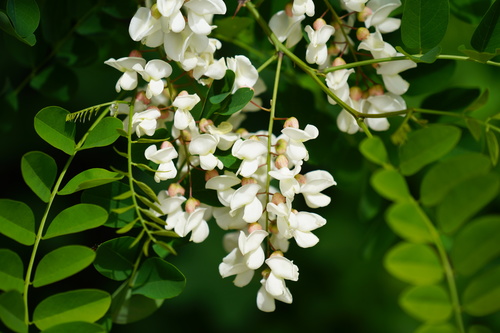
Robinia pseudoacacia
Black locust · also False acacia, Yellow locust, Locust tree
Report an issue with this species
Robinia pseudoacacia, commonly known as black locust, is a rapidly growing deciduous tree with a rounded crown. It is native to the southeastern United States and is valued for its ornamental appeal and nitrogen-fixing properties. However, it can be invasive due to aggressive root suckering and its seeds, leaves, and bark are poisonous.
Where it grows
Trees in each city's inventory, with the share of that city's named trees this species accounts for.
- 12,5191.1%—4.5 in
- 9,9262.3%43 yr15 in
- 6,0022.1%29 yr9.8 in
- 3,5260.75%36 yr18 in
- 2,9420.43%—9.8 in
- 2,4291.1%—11 in
- 2,1680.63%—9.8 in
- 1,9230.27%—14 in
- 1,5533.2%15 yr2.4 in
- 1,2230.45%—8.7 in
- 9130.50%—17 in
- 9070.27%5.0 yr5.9 in
- 8650.44%6.9 yr11 in
- 5820.18%—9.8 in
- 3720.12%—9.0 in
- 3420.46%—13 in
- 3220.27%—15 in
- 2630.17%—3.8 in
- 1860.25%8.8 yr4.7 in
- 1790.38%—9.8 in
- 1750.21%—5.9 in
- 1550.65%—9.4 in
- 1530.44%—20 in
- 1310.83%23 yr15 in
- 1261.1%—22 in
- 290.01%—11 in
- 270.02%3.2 yr2.0 in
- 240.21%2.3 yr7.9 in
- 220.27%——
- 210.02%—11 in
- 190.04%—9.1 in
- 20.01%——
Traits
- Form
- Broadleaf
- Foliage
- Deciduous
- Mature height
- 40–70 ft
- Canopy spread
- 25–35 ft
- Growth rate
- Fast
- Soil
- Sandy, Rocky, Poor-soil-tolerant
- Water needs
- Moderate
- Drought tolerance
- Moderate
- Pollution tolerance
- High
- Roots
- Invasive
- Wildlife value
- High
- Blooms
- Jun, Jul
Trunk diameters across every city: median 9.4 in, mean 12 in, 90th percentile 23 in. Measured at breast height, as published by each inventory.
Native range
Terrestrial ecoregions where this species is native. Trees in the dataset mostly stand well outside it.
Temperate Broadleaf & Mixed Forests
- Allegheny Highlands forests
- Appalachian mixed mesophytic forests
- Appalachian Piedmont forests
- Appalachian-Blue Ridge forests
Other Robinia in the catalogue
7 of the top 2,000 species are in this genus.


