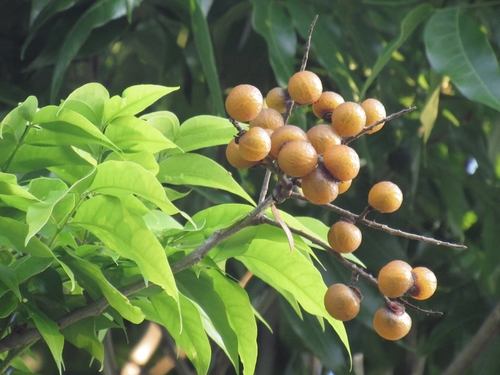
Sapindus saponaria
Report an issueBy recorded trees in the inventory.
Western soapberry · also Wingleaf soapberry, Soapberry, Manele
A small to medium-sized deciduous tree with a lush, wide canopy of pinnately-compound leaves and clusters of golden-yellow, soap-producing berries. Extremely hardy, drought-tolerant, and adaptable to poor soils, making it a resilient urban or shade tree.
Species colors
- Trunk
- #a1a1a1
- Foliage
- #4f7a3e
- Fall foliage
- #e8b831
Traits
- Form & size
- FormBroadleafMature height20–50 ftCanopy spread35 ft
- Deciduous foliage
- Blooms
- May, Jun, Nov
- Sun
- Full sun, Part shade
- Soil
- Well-drained, Clay-tolerant
- Moderate water needs
- High drought tolerance
- Tolerates
- coastal, salt
Size sketches use the middle of each recorded range (or the available bound), beside a 6 ft person. Missing dimensions are illustrative.
Trunk diameters across every city: median 8.0 in, mean 9.2 in, 90th percentile 18 in. Measured at breast height, as published by each inventory.
Where it grows
Cities that list the tree in their inventory, and what % of their named trees it represents.
- 280.01%—7.5 in
- 280.05%—8.0 in
- 20.01%—9.5 in
- 10.00%—15 in
No city in this list records planting dates for this species, so age is blank throughout.
Native range
Ecoregions where the species is native.
Tropical & Subtropical Moist Broadleaf Forests
- Central American Atlantic moist forests
- Central American montane forests
- Northeast Brazil restingas
- Trinidad and Tobago moist forest
- Cook Islands tropical moist forests
- Marquesas tropical moist forests
- Society Islands tropical moist forests
- Tuamotu tropical moist forests
Tropical & Subtropical Dry Broadleaf Forests
- Central American dry forests
- Trinidad and Tobago dry forest
Tropical & Subtropical Coniferous Forests
- Central American pine-oak forests
Other Sapindus in the catalogue
3 of the top 2,000 species are in this genus.

