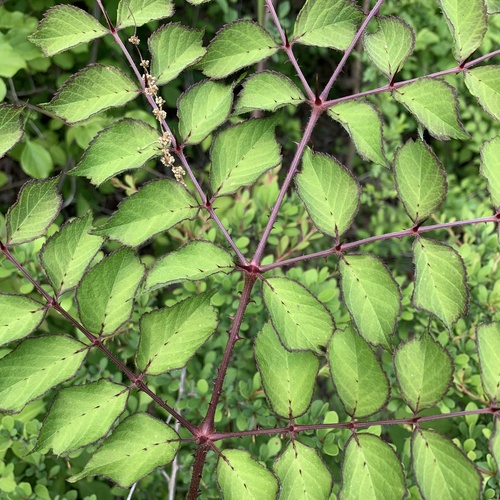
Aralia elata
Japanese angelica tree · also Chinese angelica-tree, Korean angelica-tree, Japanese angelica
Report an issue with this species
Aralia elata is a multi-stemmed small tree native to East Asia with an umbrella-like canopy of pinnately compound leaves and spiny, unbranched stems. It grows rapidly and is considered invasive in many regions due to birds dispersing its seeds from small black drupes. Its flowers are produced in lace-like umbels, and young shoots are edible.
Where it grows
Trees in each city's inventory, with the share of that city's named trees this species accounts for.
- 140.01%—4.5 in
- 100.00%—1.6 in
- 90.01%—3.1 in
- 60.00%5.8 yr5.9 in
- 50.00%—2.8 in
- 30.00%——
- 10.00%—14 in
Traits
- Form
- Multi-trunk
- Foliage
- Deciduous
- Mature height
- 35–45 ft
- Canopy spread
- 30–40 ft
- Growth rate
- Moderate
- Wildlife value
- High
- Blooms
- Jun, Jul, Aug
Trunk diameters across every city: median 4.4 in, mean 4.8 in, 90th percentile 8.9 in. Measured at breast height, as published by each inventory.
Native range
Terrestrial ecoregions where this species is native. Trees in the dataset mostly stand well outside it.
Temperate Broadleaf & Mixed Forests
- Central China Loess Plateau mixed forests
- Central Korean deciduous forests
- Northeast China Plain deciduous forests
- Southern Korea evergreen forests
Tropical & Subtropical Moist Broadleaf Forests
- South Taiwan monsoon rain forests
Other Aralia in the catalogue
2 of the top 2,000 species are in this genus.
