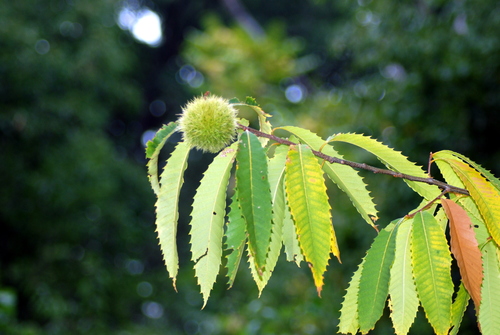
Castanea dentata
American chestnut · also Toothed chestnut
Report an issue with this species
The American chestnut is a large, fast-growing deciduous tree native to eastern North America, historically a dominant species in oak-chestnut forests. It provides shade and features toothed leaves with yellow-orange fall colors and decorative, prickly fruits that are popular with wildlife. Though functionally extinct in its native range due to chestnut blight, its roots persist, leading to multi-trunked saplings that eventually succumb to the disease, making it currently unsuitable for widespread urban planting without blight resistance.
Where it grows
Trees in each city's inventory, with the share of that city's named trees this species accounts for.
- 370.05%1.8 yr2.0 in
- 250.00%—9.0 in
- 240.00%—3.9 in
- 110.00%36 yr7.5 in
- 110.01%—31 in
- 80.00%—9.1 in
- 70.01%23 yr5.5 in
- 50.01%—24 in
- 50.00%——
- 20.00%—3.8 in
- 10.01%——
- 10.00%——
- 10.00%—1.2 in
Traits
- Foliage
- Deciduous
- Mature height
- 50–80 ft
- Canopy spread
- 75 ft
- Growth rate
- Fast
- Wildlife value
- High
- Blooms
- Mar, Apr, May, Jun, Jul, Aug
Trunk diameters across every city: median 4.0 in, mean 9.6 in, 90th percentile 27 in. Measured at breast height, as published by each inventory.
Native range
Terrestrial ecoregions where this species is native. Trees in the dataset mostly stand well outside it.
Temperate Broadleaf & Mixed Forests
- Mississippi lowland forests
- New England-Acadian forests
Other Castanea in the catalogue
4 of the top 2,000 species are in this genus.

