Castanea
Chestnut · also Sweet chestnut
Report an issue with this species
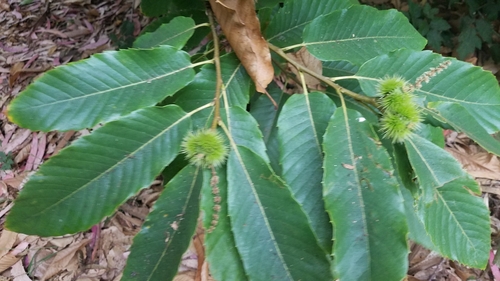
Chestnuts are deciduous trees known for their deeply grooved bark, leathery leaves, and edible nuts encased in prickly husks. They typically form a large, rounded crown and are native to temperate woodlands, exhibiting allelopathic properties. Widely cultivated for their nuts and durable timber, they are hardy but prefer mild climates with sufficient moisture, and some cultivars are notably resistant to chestnut blight.
Where it grows
Trees in each city's inventory, with the share of that city's named trees this species accounts for.
- 790.03%—6.3 in
- 510.00%—5.0 in
- 130.00%—19 in
- 100.02%——
- 90.01%—10 in
- 20.00%—1.9 in
- 10.01%——
No city in this list records planting dates for this species, so age is blank throughout.
Traits
- Form
- Broadleaf
- Foliage
- Deciduous
- Mature height
- 40–60 ft
- Canopy spread
- 40–60 ft
- Lifespan
- 200 years
- Growth rate
- Fast
- Wildlife value
- Moderate
- Blooms
- Jun, Jul
Trunk diameters across every city: median 5.6 in, mean 6.0 in, 90th percentile 8.3 in. Measured at breast height, as published by each inventory.
Native range
Terrestrial ecoregions where this species is native. Trees in the dataset mostly stand well outside it.
Temperate Broadleaf & Mixed Forests
- Balkan mixed forests
- Caucasus mixed forests
Temperate Conifer Forests
- Elburz Range forest steppe
Mediterranean Forests, Woodlands & Scrub
- Aegean and Western Turkey sclerophyllous and mixed forests
Other Castanea in the catalogue
4 of the top 2,000 species are in this genus.


