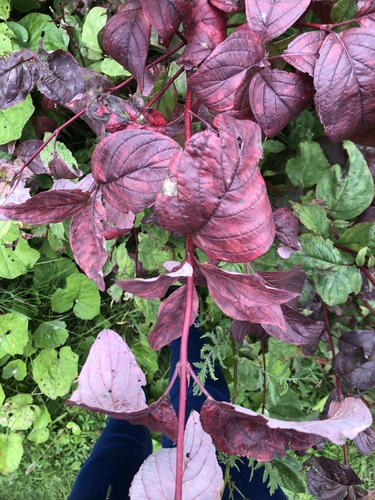
Cornus sericea
Red osier dogwood · also Red-osier dogwood, Red brush, Red willow
Report an issue with this species
Cornus sericea, also known as red twig dogwood, is notable for its striking red stems, which become particularly vibrant in winter. It thrives in moist areas like wetland margins. This shrub produces small, fragrant white flowers followed by bluish fruits that are attractive to birds.
Where it grows
Trees in each city's inventory, with the share of that city's named trees this species accounts for.
- 580.12%—0.8 in
- 350.01%—0.8 in
- 230.01%—2.4 in
- 120.02%—1.6 in
- 120.01%16 yr—
- 100.00%—3.9 in
- 10.01%—3.9 in
Traits
- Form
- Spreading
- Foliage
- Deciduous
- Mature height
- 5–10 ft
- Canopy spread
- 12–15 ft
- Growth rate
- Moderate
- Wildlife value
- High
- Blooms
- Jun, Jul, Aug, Sep, Oct, Nov
Trunk diameters across every city: median 0.8 in, mean 1.4 in, 90th percentile 2.4 in. Measured at breast height, as published by each inventory.
Native range
Terrestrial ecoregions where this species is native. Trees in the dataset mostly stand well outside it.
Temperate Conifer Forests
- Alberta-British Columbia foothills forests
- Arizona Mountains forests
- British Columbia coastal conifer forests
- Central British Columbia Mountain forests
- Colorado Rockies forests
- Northern California coastal forests
- Northern Pacific Alaskan coastal forests
Temperate Broadleaf & Mixed Forests
- Northeast US Coastal forests
- Western Great Lakes forests
Temperate Grasslands, Savannas & Shrublands
- California Central Valley grasslands
Tundra
- Alaska-St. Elias Range tundra
Other Cornus in the catalogue
16 of the top 2,000 species are in this genus.


