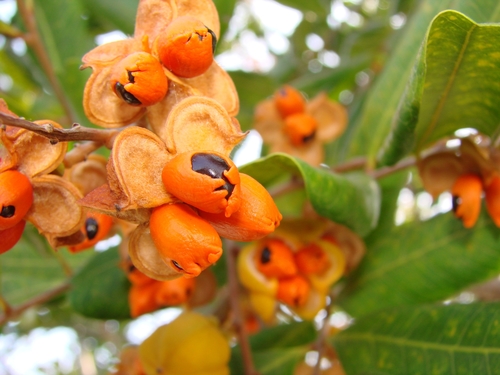
Cupaniopsis
Carrot wood · also Weeping flower tamarind, Tuckeroo, Beach tamarind
Report an issue with this species
Cupaniopsis trees typically feature a dense, rounded to broad canopy with glossy, dark green leaves. They produce small, inconspicuous flowers followed by vibrant orange, capsule-like fruits, adding seasonal color. These trees are well-suited for urban landscapes, showing tolerance to drought, salt, and coastal conditions, and requiring minimal maintenance.
Where it grows
Trees in each city's inventory, with the share of that city's named trees this species accounts for.
- 2660.17%11 yr7.9 in
Traits
- Form
- Broadleaf
- Foliage
- Evergreen
- Mature height
- 40 ft
- Canopy spread
- 30 ft
- Growth rate
- Moderate
- Water needs
- Low
- Drought tolerance
- High
- Tolerates
- coastal, salt
- Blooms
- Jan, Feb, Mar, Apr, May, Jun, Jul, Aug, Dec
Trunk diameters across every city: median 7.9 in, mean 9.2 in, 90th percentile 16 in. Measured at breast height, as published by each inventory.
Native range
Terrestrial ecoregions where this species is native. Trees in the dataset mostly stand well outside it.
Tropical & Subtropical Moist Broadleaf Forests
- Central Range Papuan montane rain forests
- New Caledonia rain forests
- Northern New Guinea lowland rain and freshwater swamp forests
- Northern New Guinea montane rain forests
- Solomon Islands rain forests
- Southern New Guinea freshwater swamp forests
- Southern New Guinea lowland rain forests
- Eastern Micronesia tropical moist forests
- Fiji tropical moist forests
Tropical & Subtropical Dry Broadleaf Forests
- New Caledonia dry forests
- Fiji tropical dry forests
Mangroves
- New Guinea mangroves
Other Cupaniopsis in the catalogue
2 of the top 2,000 species are in this genus.
