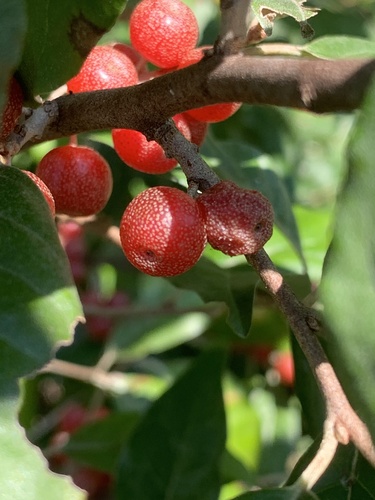
Elaeagnus umbellata
Japanese silverberry · also Umbellata oleaster, Autumn olive, Autumn elaeagnus
Report an issue with this species
Elaeagnus umbellata, also known as autumn olive, is a flowering plant indigenous to eastern Asia. It is a hardy and aggressive invasive species, capable of colonizing barren land. Due to its invasive nature, it has become a concern in many regions where it was introduced.
Where it grows
Trees in each city's inventory, with the share of that city's named trees this species accounts for.
- 120.01%23 yr13 in
- 30.00%—12 in
- 20.00%——
- 20.00%—7.1 in
- 10.00%——
- 10.00%—3.0 in
- 10.00%—0.4 in
- 10.00%—2.0 in
Traits
- Growth rate
- Fast
Trunk diameters across every city: median 13 in, mean 11 in, 90th percentile 13 in. Measured at breast height, as published by each inventory.
Native range
Terrestrial ecoregions where this species is native. Trees in the dataset mostly stand well outside it.
Temperate Broadleaf & Mixed Forests
- Eastern Himalayan broadleaf forests
- Western Himalayan broadleaf forests
- Central China Loess Plateau mixed forests
- Central Korean deciduous forests
- Northeast China Plain deciduous forests
- Southern Korea evergreen forests
Temperate Conifer Forests
- Eastern Himalayan subalpine conifer forests
- Western Himalayan subalpine conifer forests
Tropical & Subtropical Moist Broadleaf Forests
- South China-Vietnam subtropical evergreen forests
Montane Grasslands & Shrublands
- Southeast Tibet shrublands and meadows
Deserts & Xeric Shrublands
- Registan-North Pakistan sandy desert
Other Elaeagnus in the catalogue
5 of the top 2,000 species are in this genus.


