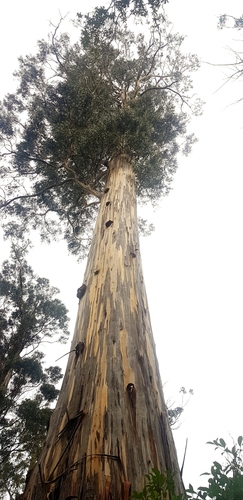
Eucalyptus globulus
Southern blue gum · also Blue gum, Tasmanian blue gum, Victorian blue gum
Report an issue with this species
Eucalyptus globulus, also known as blue gum, is a tall, evergreen tree with mostly smooth bark, lance-shaped adult leaves, white flowers, and woody fruit. Native to southeastern Australia, it forms tall, open forests and is adapted to temperate climates. It is widely cultivated globally for timber, paper pulp, and as an ornamental, and its fast growth rate and wide-spreading roots make it useful for erosion control, but it can be an invasive species in some regions.
Where it grows
Trees in each city's inventory, with the share of that city's named trees this species accounts for.
- 33,4322.3%—17 in
- 3,1380.67%35 yr18 in
- 4110.31%—25 in
- 1170.08%—5.6 in
- 160.01%—15 in
- 100.00%—1.5 in
- 40.00%——
- 30.01%—4.0 in
- 10.00%—12 in
Traits
- Form
- Broadleaf
- Foliage
- Evergreen
- Mature height
- 50–80 ft
- Canopy spread
- 30–75 ft
- Growth rate
- Fast
- Water needs
- High
- Roots
- Invasive
- Wildlife value
- High
- Blooms
- Jun, Jul, Aug, Sep, Oct, Nov
Trunk diameters across every city: median 18 in, mean 20 in, 90th percentile 33 in. Measured at breast height, as published by each inventory.
Native range
Terrestrial ecoregions where this species is native. Trees in the dataset mostly stand well outside it.
Temperate Broadleaf & Mixed Forests
- Southeast Australia temperate forests
- Tasmanian Central Highland forests
- Tasmanian temperate forests
- Tasmanian temperate rain forests
Other Eucalyptus in the catalogue
57 of the top 2,000 species are in this genus.


