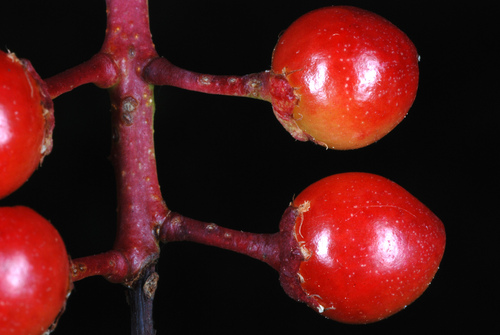
Prunus serotina
Black cherry · also Wild black cherry, Rum cherry, Mountain black cherry
Report an issue with this species
Prunus serotina is a deciduous tree or shrub, known for its adaptable form, growing tall and slender in crowded spaces or spreading with arching branches in open areas. It features small, white, fragrant flowers in spring and shiny leaves that offer yellow, orange, and pink fall color. Native to the Americas, it attracts birds and butterflies, and is notably resistant to oak root fungus, though all parts except the seedless fruits are poisonous.
Where it grows
Trees in each city's inventory, with the share of that city's named trees this species accounts for.
- 33,1072.3%—11 in
- 1,2370.17%—12 in
- 4400.16%—9.8 in
- 4380.58%3.8 yr5.3 in
- 4150.36%—13 in
- 4090.12%4.5 yr2.0 in
- 2630.08%—9.8 in
- 2560.04%—12 in
- 2540.54%—11 in
- 1490.03%40 yr10 in
- 1350.07%—18 in
- 1260.15%—6.3 in
- 610.03%—19 in
- 550.02%45 yr9.8 in
- 300.04%—4.7 in
- 290.00%—1.5 in
- 250.01%—3.0 in
- 60.04%—9.1 in
- 50.00%—4.4 in
- 50.04%—12 in
- 50.04%—20 in
- 30.00%—8.7 in
- 10.00%—7.9 in
- 10.00%—2.0 in
- 10.00%—18 in
Traits
- Form
- Spreading
- Foliage
- Deciduous
- Mature height
- 50 ft
- Canopy spread
- 25–30 ft
- Growth rate
- Fast
- Water needs
- Moderate
- Wildlife value
- High
- Blooms
- Mar, Apr, May
Trunk diameters across every city: median 10 in, mean 12 in, 90th percentile 23 in. Measured at breast height, as published by each inventory.
Native range
Terrestrial ecoregions where this species is native. Trees in the dataset mostly stand well outside it.
Temperate Conifer Forests
- Arizona Mountains forests
- Central British Columbia Mountain forests
- Colorado Rockies forests
Temperate Broadleaf & Mixed Forests
- Ozark Mountain forests
Other Prunus in the catalogue
60 of the top 2,000 species are in this genus.


