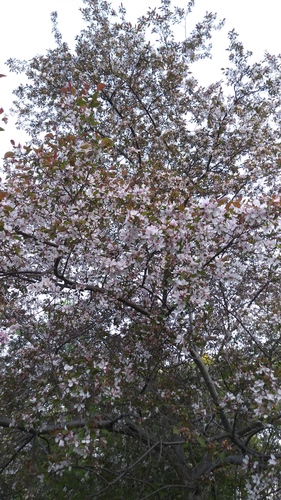

Prunus cerasifera
Report an issueSpecies #47Genus #6 · Prunus
By recorded trees in the inventory.
Cherry plum · also Myrobalan plum, Purple-leaf plum
Deciduous
71,225
trees mapped
0.54%
of all named trees
48
cities
5.0 in
median trunk (13 cm, 60,618 measured)
Prunus cerasifera, also known as cherry plum and myrobalan plum, is a small deciduous tree that is one of the parents of the cultivated plum. It is not suited to compacted soil.
Traits
- Form & size
- Mature height15–25 ftCanopy spread15–20 ft
- Deciduous foliage
- Blooms
- Mar, Apr, May
- Fast growth rate
- Sun
- Full sun, Part shade
- Soil
- Well-drained, Clay-tolerant
- Moderate water needs
- Moderate drought tolerance
- High wildlife value
Size sketches use the middle of each recorded range (or the available bound), beside a 6 ft person. Missing dimensions are illustrative.
Trunk diameters across every city: median 5.0 in, mean 6.9 in, 90th percentile 15 in. Measured at breast height, as published by each inventory.
Where it grows
Cities that list the tree in their inventory, and what % of their named trees it represents.
- 18,3501.6%—2.8 in
- 10,7685.9%—12 in
- 10,0890.93%—5.0 in
- 5,6853.6%—5.0 in
- 5,6092.2%16 yr3.9 in
- 3,3601.2%—5.9 in
- 2,7391.1%28 yr9.0 in
- 2,0605.9%—13 in
- 1,6840.55%—3.0 in
- 1,2361.2%——
- 1,0440.37%32 yr5.9 in
- 1,0290.45%—8.1 in
- 1,0291.2%—12 in
- 9980.24%—3.0 in
- 7010.20%—3.5 in
- 6670.15%28 yr8.8 in
- 5921.00%11 yr3.0 in
- 5900.35%—3.0 in
- 3700.83%—14 in
- 3650.45%11 yr—
- 3331.0%18 yr—
- 2800.14%11 yr6.5 in
- 2701.7%—16 in
- 2370.39%——
- 2300.12%—5.0 in
- 1590.32%11 yr2.4 in
- 1460.07%—2.5 in
- 1400.03%—5.0 in
- 960.19%—4.0 in
- 850.02%6.3 yr3.9 in
- 830.22%—3.0 in
- 310.50%12 yr6.0 in
- 240.01%—3.9 in
- 220.02%—2.0 in
- 190.01%10 yr5.5 in
- 190.01%—2.4 in
- 180.02%12 yr—
- 130.22%—6.3 in
- 100.08%7.9 yr2.0 in
- 100.06%——
- 90.00%—3.1 in
- 60.01%14 yr2.0 in
- 50.02%—6.0 in
- 40.02%—16 in
- 40.01%—4.1 in
- 30.01%—3.0 in
- 20.01%—2.0 in
- 20.00%—3.7 in
Native range
Ecoregions where the species is native.
Native habitat · 6 ecoregions
Temperate Broadleaf & Mixed Forests
- Eastern Himalayan broadleaf forests
- Western Himalayan broadleaf forests
- Balkan mixed forests
- Caucasus mixed forests
- East European forest steppe
- Eastern Anatolian deciduous forests
Native habitat · 4 ecoregions
Temperate Conifer Forests
- Eastern Himalayan subalpine conifer forests
- Western Himalayan subalpine conifer forests
- East Afghan montane conifer forests
- Elburz Range forest steppe
Native habitat · 2 ecoregions
Temperate Grasslands, Savannas & Shrublands
- Alai-Western Tian Shan steppe
- Eastern Anatolian montane steppe
Native habitat · 1 ecoregion
Montane Grasslands & Shrublands
- Kuh Rud and Eastern Iran montane woodlands
Native habitat · 1 ecoregion
Mediterranean Forests, Woodlands & Scrub
- Aegean and Western Turkey sclerophyllous and mixed forests
Native habitat · 1 ecoregion
Deserts & Xeric Shrublands
- Registan-North Pakistan sandy desert
Other Prunus in the catalogue
59 of the top 2,000 species are in this genus.


