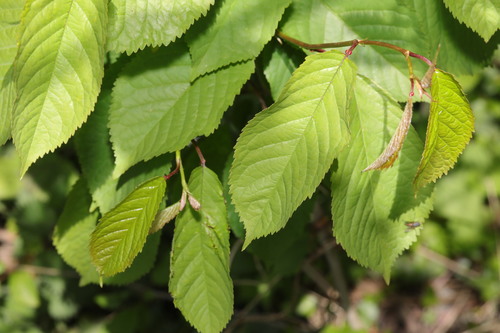
Prunus avium
Wild cherry · also Sweet cherry, Gean, Bird cherry
Report an issue with this species
Prunus avium, also known as wild cherry or sweet cherry, is a large deciduous tree with a rounded crown. Native to Western Eurasia, it is valued for its showy spring blossoms, which provide an important nectar and pollen source for pollinators. It produces edible fruit and is commonly planted as an ornamental.
Where it grows
Trees in each city's inventory, with the share of that city's named trees this species accounts for.
- 30,2272.7%—3.0 in
- 3,1761.1%25 yr9.8 in
- 2,0080.88%—5.0 in
- 1,9810.45%31 yr9.0 in
- 1,5003.1%15 yr2.4 in
- 6500.36%—16 in
- 2120.07%—3.0 in
- 520.01%—4.5 in
- 520.15%—20 in
- 470.06%17 yr2.0 in
- 370.01%3.0 yr2.0 in
- 300.19%—15 in
- 190.00%35 yr4.5 in
- 90.00%—10 in
- 90.01%—9.0 in
- 50.01%—1.2 in
- 10.00%—12 in
Traits
- Form
- Broadleaf
- Foliage
- Deciduous
- Mature height
- 50–70 ft
- Canopy spread
- 20–30 ft
- Growth rate
- Moderate
- Water needs
- Moderate
- Drought tolerance
- Moderate
- Wildlife value
- High
- Blooms
- Mar, Apr, May
Trunk diameters across every city: median 3.5 in, mean 4.7 in, 90th percentile 8.9 in. Measured at breast height, as published by each inventory.
Native range
Terrestrial ecoregions where this species is native. Trees in the dataset mostly stand well outside it.
Temperate Broadleaf & Mixed Forests
- Appenine deciduous montane forests
- Eastern Anatolian deciduous forests
- Western European broadleaf forests
Temperate Conifer Forests
- Elburz Range forest steppe
- Mediterranean conifer and mixed forests
- Northern Anatolian conifer and deciduous forests
Mediterranean Forests, Woodlands & Scrub
- Cyprus Mediterranean forests
- Northeast Spain and Southern France Mediterranean forests
Montane Grasslands & Shrublands
- Kuh Rud and Eastern Iran montane woodlands
Other Prunus in the catalogue
60 of the top 2,000 species are in this genus.


