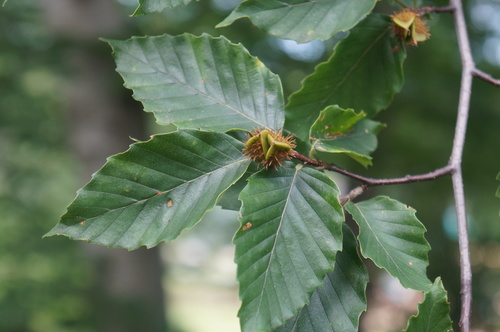
Fagus
Beech · also American beech, European beech, North American beech
Report an issue with this species
Deciduous trees native to Eurasia and North America, typically large with dense canopies and smooth grey bark, whose foliage often turns golden bronze in fall. They produce nuts valuable to wildlife and have shallow, widespread roots, preferring well-drained soils and ample space.
Where it grows
Trees in each city's inventory, with the share of that city's named trees this species accounts for.
- 3140.05%—7.9 in
- 2030.05%34 yr8.1 in
- 1370.01%—5.0 in
- 840.11%—7.1 in
- 590.02%—5.1 in
- 480.10%127 yr—
- 370.05%—4.7 in
- 350.15%—6.7 in
- 130.04%—2.8 in
- 110.00%—3.0 in
- 100.01%—11 in
- 90.01%—6.7 in
- 80.00%—4.1 in
- 50.00%—6.3 in
- 50.00%—4.1 in
- 40.00%—14 in
- 30.00%——
- 20.02%——
- 10.01%—21 in
- 10.00%—2.0 in
- 10.00%——
Traits
- Foliage
- Deciduous
- Mature height
- 50–140 ft
- Canopy spread
- 50–80 ft
- Growth rate
- Moderate
- Soil
- Well-drained, Sandy, Chalky
- Water needs
- Moderate
- Roots
- Moderate
- Wildlife value
- High
- Blooms
- Mar, Apr, May
Trunk diameters across every city: median 7.1 in, mean 9.5 in, 90th percentile 20 in. Measured at breast height, as published by each inventory.
Native range
Terrestrial ecoregions where this species is native. Trees in the dataset mostly stand well outside it.
Temperate Broadleaf & Mixed Forests
- Appalachian mixed mesophytic forests
- Eastern Canadian Forest-Boreal transition
- Eastern Great Lakes lowland forests
- Southern Great Lakes forests
- Western Great Lakes forests
- Balkan mixed forests
- Baltic mixed forests
- Caucasus mixed forests
- Central European mixed forests
- English Lowlands beech forests
Temperate Conifer Forests
- Northern Anatolian conifer and deciduous forests
Other Fagus in the catalogue
6 of the top 2,000 species are in this genus.


