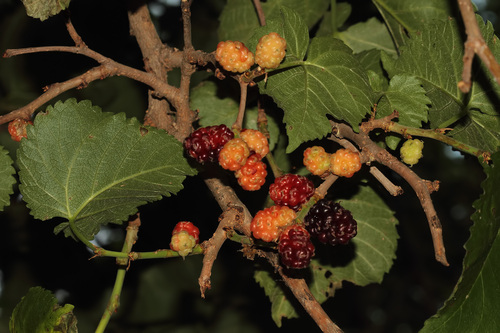
Morus nigra
Morus nigra · also Black mulberry, Morera, Toot tree
Report an issue with this species
Morus nigra, or black mulberry, is a deciduous tree known for its gnarled branches, dark furrowed bark, and heart-shaped leaves that turn yellow in autumn. It produces inconspicuous flowers followed by edible black to red fruits popular with birds. This species tolerates urban pollution and cold, but can produce messy fruit litter and has toxic sap and unripe fruit.
Where it grows
Trees in each city's inventory, with the share of that city's named trees this species accounts for.
- 5370.15%—9.4 in
- 3970.03%—2.5 in
- 620.03%—3.1 in
- 560.01%14 yr6.9 in
- 430.01%22 yr9.8 in
- 200.04%2.8 yr—
- 170.21%——
- 140.01%—4.0 in
- 80.00%36 yr7.5 in
- 20.00%—1.9 in
Traits
- Foliage
- Deciduous
- Mature height
- 30 ft
- Canopy spread
- 35 ft
- Growth rate
- Fast
- Water needs
- Moderate
- Pollution tolerance
- High
- Wildlife value
- Moderate
- Blooms
- Mar, Apr, May
Trunk diameters across every city: median 5.9 in, mean 8.5 in, 90th percentile 20 in. Measured at breast height, as published by each inventory.
Native range
Terrestrial ecoregions where this species is native. Trees in the dataset mostly stand well outside it.
Temperate Conifer Forests
- Elburz Range forest steppe
Montane Grasslands & Shrublands
- Kuh Rud and Eastern Iran montane woodlands
Deserts & Xeric Shrublands
- South Iran Nubo-Sindian desert and semi-desert
Other Morus in the catalogue
5 of the top 2,000 species are in this genus.


