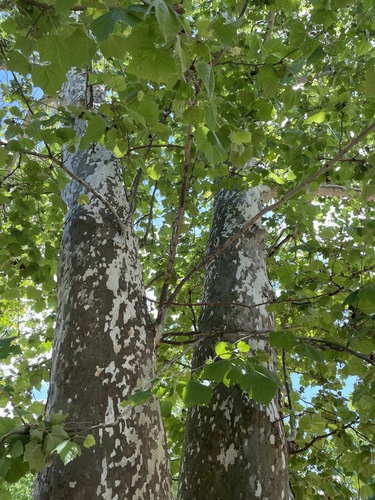
Platanus occidentalis
American sycamore · also American planetree, Buttonwood, Water beech
Report an issue with this species
The American sycamore is a massive deciduous tree native to eastern and central North America, often found in bottomlands and floodplains. It is easily recognized by its distinctive exfoliating bark, which reveals a mottled pattern of grey, greenish-white, and brown. This tree prefers moist, well-drained soils, tolerates clay and flooding, making it suitable for urban street or park plantings despite its susceptibility to sycamore anthracnose.
Where it grows
Trees in each city's inventory, with the share of that city's named trees this species accounts for.
- 1,9560.85%—13 in
- 1,9380.98%5.8 yr9.8 in
- 1,1530.16%—26 in
- 1,0830.93%33 yr22 in
- 8481.1%3.8 yr2.0 in
- 6470.19%3.4 yr2.0 in
- 1650.05%—27 in
- 1540.03%36 yr9.0 in
- 1120.15%5.8 yr1.6 in
- 720.01%—7.7 in
- 710.04%6.0 yr2.0 in
- 620.52%6.8 yr2.0 in
- 340.29%3.3 yr2.1 in
- 230.00%—5.0 in
- 170.00%—8.1 in
- 150.00%——
- 140.03%—3.9 in
- 120.00%13 yr5.9 in
- 90.00%—12 in
- 40.00%—24 in
- 30.00%—14 in
- 10.00%—24 in
- 10.00%—1.9 in
Traits
- Form
- Broadleaf
- Foliage
- Deciduous
- Mature height
- 50–90 ft
- Canopy spread
- 50 ft
- Lifespan
- 200–600 years
- Growth rate
- Fast
- USDA zones
- 7
- Sun
- Full sun
- Soil
- Well-drained, Moist, Clay-tolerant
- Water needs
- Moderate
- Wildlife value
- Moderate
- Blooms
- Mar, Apr, May
Trunk diameters across every city: median 12 in, mean 15 in, 90th percentile 32 in. Measured at breast height, as published by each inventory.
Native range
Terrestrial ecoregions where this species is native. Trees in the dataset mostly stand well outside it.
Temperate Broadleaf & Mixed Forests
- Mississippi lowland forests
- New England-Acadian forests
Other Platanus in the catalogue
8 of the top 2,000 species are in this genus.


