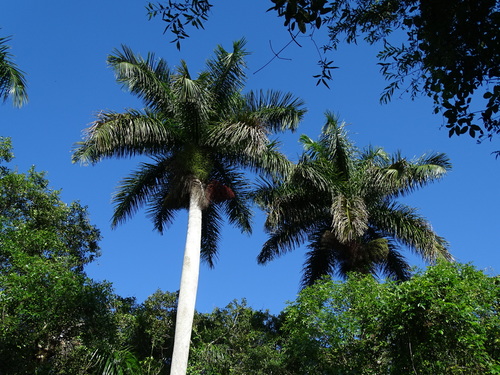
Roystonea regia
Royal palm · also Cuban royal palm, Florida royal palm
Report an issue with this species
Roystonea regia, commonly known as the royal palm, is a large and attractive palm with a trunk often tapered at both ends and slightly bulged in the middle. It is widely planted as an ornamental tree in tropical and subtropical regions. The fruit provides food for birds and bats, and the tree serves as a roosting site and food source for various urban wildlife.
Where it grows
Trees in each city's inventory, with the share of that city's named trees this species accounts for.
- 2,9041.8%—14 in
- 20.00%——
- 10.00%—9.1 in
No city in this list records planting dates for this species, so age is blank throughout.
Traits
- Form
- Palm
- Foliage
- Evergreen
- Mature height
- 50–80 ft
- Canopy spread
- 10–20 ft
- Water needs
- High
- Drought tolerance
- Low
- Wildlife value
- High
- Tolerates
- coastal, salt
Trunk diameters across every city: median 14 in, mean 14 in, 90th percentile 18 in. Measured at breast height, as published by each inventory.
Native range
Terrestrial ecoregions where this species is native. Trees in the dataset mostly stand well outside it.
Tropical & Subtropical Moist Broadleaf Forests
- Central American Atlantic moist forests
Tropical & Subtropical Dry Broadleaf Forests
- Cuban dry forests
Mangroves
- Mesoamerican Gulf-Caribbean mangroves