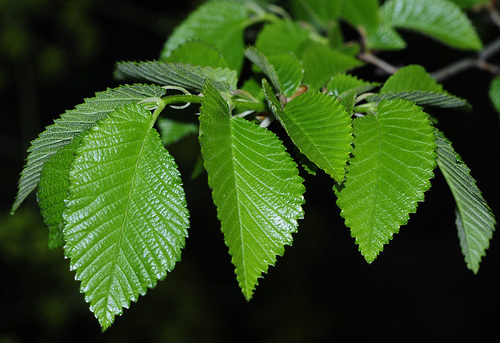
Ulmus carpinifolia
Smooth-leaf elm · also Small leaved elm, Smoothleaf elm, Field elm
Report an issue with this species
Ulmus minor Mill., the field elm, is a polymorphic European species with a natural range extending to Asia Minor and Iran, tolerating both summer floods and droughts. It is characterized by arching, slender branches and deciduous foliage with asymmetrical, double-serrated leaves. The species offers dappled shade and is notably hardy against drought, pollution, and salt, but its ability to sucker from roots can be a concern in urban settings.
Where it grows
Trees in each city's inventory, with the share of that city's named trees this species accounts for.
- 1,2791.1%—5.0 in
- 1,0803.1%—18 in
- 2800.09%—3.0 in
- 1490.08%11 yr7.2 in
- 610.75%——
- 190.01%—22 in
- 140.01%—4.5 in
- 50.00%——
- 40.00%——
- 20.00%——
- 10.00%—27 in
- 10.00%——
Traits
- Foliage
- Deciduous
- Mature height
- 50–60 ft
- Canopy spread
- 50–70 ft
- Growth rate
- Fast
- Water needs
- Moderate
- Drought tolerance
- High
- Pollution tolerance
- High
- Roots
- Invasive
- Tolerates
- coastal, salt
- Blooms
- Jan, Feb, Dec
Trunk diameters across every city: median 7.9 in, mean 11 in, 90th percentile 28 in. Measured at breast height, as published by each inventory.
Native range
Terrestrial ecoregions where this species is native. Trees in the dataset mostly stand well outside it.
Temperate Broadleaf & Mixed Forests
- Baltic mixed forests
- Central European mixed forests
- East European forest steppe
- Eastern Anatolian deciduous forests
- European Atlantic mixed forests
- Western European broadleaf forests
Temperate Conifer Forests
- Northern Anatolian conifer and deciduous forests
Montane Grasslands & Shrublands
- Kuh Rud and Eastern Iran montane woodlands
Mediterranean Forests, Woodlands & Scrub
- Aegean and Western Turkey sclerophyllous and mixed forests
Other Ulmus in the catalogue
28 of the top 2,000 species are in this genus.


