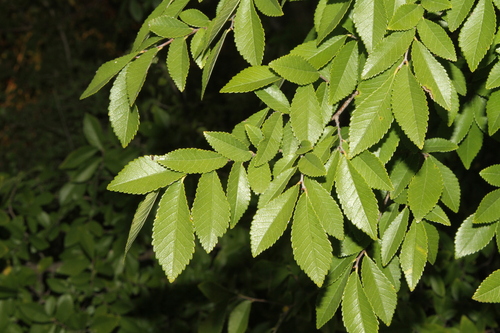
Ulmus parvifolia
Chinese elm · also Lacebark elm
Report an issue with this species
Ulmus parvifolia, also known as Chinese elm, features a graceful, arching canopy with small leaves that turn golden yellow in fall. Its distinctive bark peels in a patchwork of gray, orange, and brown. This highly adaptable and urban-tolerant tree grows at a moderate rate, providing ample shade and demonstrating resilience against pests and diseases.
Where it grows
Trees in each city's inventory, with the share of that city's named trees this species accounts for.
- 11,5842.5%35 yr15 in
- 4,1200.57%—8.0 in
- 4,0882.1%12 yr8.2 in
- 1,8931.4%—8.0 in
- 1,2980.80%—9.2 in
- 1,1884.5%—4.0 in
- 1,1500.17%—14 in
- 8110.36%—7.9 in
- 6970.46%—3.8 in
- 6260.53%—4.0 in
- 2870.38%3.8 yr2.0 in
- 1260.04%41 yr14 in
- 1230.04%—3.0 in
- 1180.04%—2.0 in
- 230.01%7.8 yr5.9 in
- 210.18%—3.9 in
- 190.01%—8.3 in
- 140.01%—2.5 in
- 80.01%—9.3 in
- 40.03%—7.5 in
- 30.00%—5.1 in
- 20.00%—12 in
- 10.00%—12 in
Traits
- Form
- Broadleaf
- Mature height
- 40–60 ft
- Canopy spread
- 50–70 ft
- Growth rate
- Fast
- Water needs
- Moderate
- Pollution tolerance
- High
- Blooms
- Jun, Jul, Aug, Sep, Oct, Nov
Trunk diameters across every city: median 9.0 in, mean 11 in, 90th percentile 21 in. Measured at breast height, as published by each inventory.
Native range
Terrestrial ecoregions where this species is native. Trees in the dataset mostly stand well outside it.
Tropical & Subtropical Moist Broadleaf Forests
- Nansei Islands subtropical evergreen forests
- South China-Vietnam subtropical evergreen forests
- South Taiwan monsoon rain forests
Temperate Broadleaf & Mixed Forests
- Central China Loess Plateau mixed forests
- Central Korean deciduous forests
- Southern Korea evergreen forests
Other Ulmus in the catalogue
28 of the top 2,000 species are in this genus.


