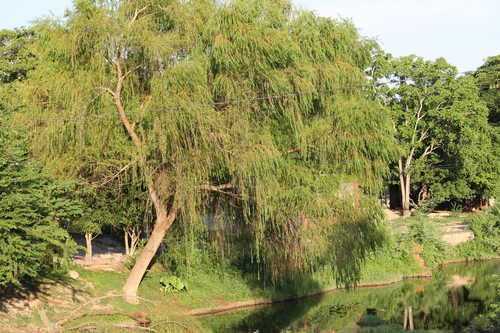
Salix babylonica
Weeping willow · also Babylon willow, Chinese weeping willow, Babylon weeping willow
Report an issue with this species
The Weeping Willow is iconic for its sprawling, lush canopy of downward-arching branches and feathery foliage. It thrives in gardens and parks along streams and bodies of water, attracting bee pollinators and butterflies. However, its extensive and potentially invasive root system means it is best planted away from urban infrastructure.
Where it grows
Trees in each city's inventory, with the share of that city's named trees this species accounts for.
- 7590.07%—5.1 in
- 5570.16%—16 in
- 4050.15%—32 in
- 3600.13%32 yr9.8 in
- 2680.15%—21 in
- 2610.11%—5.3 in
- 2560.03%—17 in
- 1990.04%35 yr7.5 in
- 970.04%—13 in
- 880.12%—32 in
- 690.44%—24 in
- 450.04%—35 in
- 420.01%—2.0 in
- 410.01%—15 in
- 410.05%—23 in
- 350.08%—5.5 in
- 330.07%9.8 yr3.9 in
- 310.09%—19 in
- 190.01%2.9 yr12 in
- 170.01%—7.0 in
- 130.01%—25 in
- 130.00%28 yr23 in
- 130.01%—7.0 in
- 70.00%2.8 yr2.4 in
- 70.01%—39 in
- 60.00%—4.7 in
- 30.00%—23 in
Traits
- Form
- Weeping
- Foliage
- Deciduous
- Mature height
- 30–50 ft
- Canopy spread
- 30–50 ft
- Growth rate
- Fast
- Water needs
- High
- Roots
- Invasive
- Wildlife value
- Moderate
- Blooms
- Mar, Apr, May
Trunk diameters across every city: median 12 in, mean 16 in, 90th percentile 35 in. Measured at breast height, as published by each inventory.
Native range
Terrestrial ecoregions where this species is native. Trees in the dataset mostly stand well outside it.
Temperate Broadleaf & Mixed Forests
- Central China Loess Plateau mixed forests
- Central Korean deciduous forests
- Northeast China Plain deciduous forests
- Southern Korea evergreen forests
Other Salix in the catalogue
34 of the top 2,000 species are in this genus.


