Salix fragilis
White crack willow · also Crack willow, Brittle willow, Hybrid crack willow
Report an issue with this species
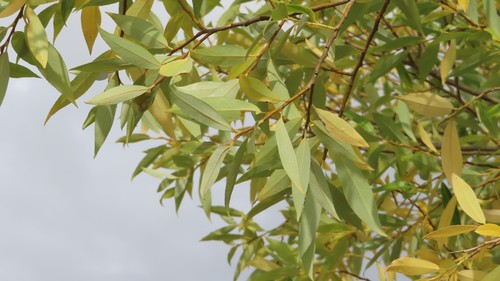
This deciduous willow tree has lanceolate to elliptic leaves that are shiny green on top and pale blue-green underneath, with dark gray-brown, deeply fissured bark. It thrives in riparian habitats, wetlands, and disturbed moist soils, reproducing easily from broken branches. While planted for erosion control and windbreaks, its aggressive growth and ability to form dense thickets make it invasive in some regions, altering hydrology and shading out native vegetation.
Where it grows
Trees in each city's inventory, with the share of that city's named trees this species accounts for.
- 2,7930.25%—5.5 in
- 5680.78%—16 in
- 4830.16%—15 in
- 920.03%—21 in
- 440.01%45 yr20 in
- 240.05%2.8 yr—
- 120.00%42 yr20 in
- 80.00%—3.8 in
- 70.00%——
- 60.00%—17 in
- 50.00%15 yr—
- 10.00%—39 in
- 10.00%—9.4 in
Traits
- Form
- Broadleaf
- Foliage
- Deciduous
- Mature height
- 30–65 ft
- Growth rate
- Fast
- Soil
- Moist
- Water needs
- High
- Roots
- Invasive
- Blooms
- Mar, Apr
Trunk diameters across every city: median 7.5 in, mean 10 in, 90th percentile 21 in. Measured at breast height, as published by each inventory.
Native range
Terrestrial ecoregions where this species is native. Trees in the dataset mostly stand well outside it.
Temperate Broadleaf & Mixed Forests
- Caucasus mixed forests
Mediterranean Forests, Woodlands & Scrub
- Aegean and Western Turkey sclerophyllous and mixed forests
Other Salix in the catalogue
34 of the top 2,000 species are in this genus.


