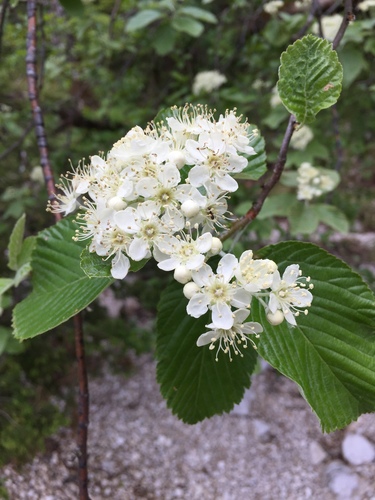
Sorbus aria
Whitebeam · also Common whitebeam
Report an issue with this species
Sorbus aria, also known as whitebeam, is a deciduous tree characterized by its compact, domed shape, upswept branches, and leaves with a whitish underside. In May, it produces cream-white flowers that develop into scarlet berries, which are a food source for birds. It typically favors dry limestone and chalk soils.
Where it grows
Trees in each city's inventory, with the share of that city's named trees this species accounts for.
- 11,6341.0%—2.8 in
- 1,6270.57%35 yr5.9 in
- 1,3590.31%33 yr7.6 in
- 6310.34%—7.0 in
- 1800.24%1.8 yr2.0 in
- 1050.67%27 yr11 in
- 990.20%16 yr8.8 in
- 870.12%9.8 yr2.0 in
- 150.01%—3.8 in
- 150.04%—2.4 in
- 40.00%—9.6 in
- 30.00%—14 in
- 30.00%—7.1 in
- 20.00%—9.8 in
Traits
- Foliage
- Deciduous
- Soil
- Well-drained
- Wildlife value
- High
- Blooms
- May
Trunk diameters across every city: median 3.5 in, mean 4.3 in, 90th percentile 9.0 in. Measured at breast height, as published by each inventory.
Native range
Terrestrial ecoregions where this species is native. Trees in the dataset mostly stand well outside it.
Temperate Broadleaf & Mixed Forests
- Appenine deciduous montane forests
- Balkan mixed forests
- North Atlantic moist mixed forests
Temperate Conifer Forests
- Northern Anatolian conifer and deciduous forests
Mediterranean Forests, Woodlands & Scrub
- Northeast Spain and Southern France Mediterranean forests
Other Sorbus in the catalogue
21 of the top 2,000 species are in this genus.


