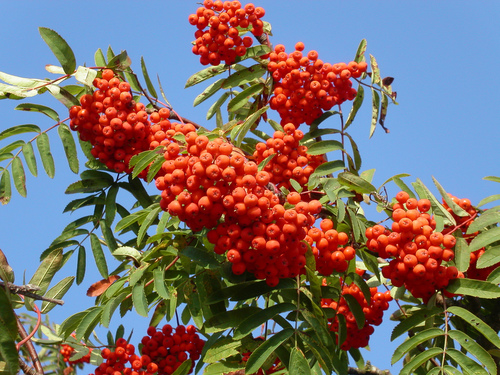
Sorbus aucuparia
Rowan · also Mountain-ash, European mountain ash, Quickbeam
Report an issue with this species
Sorbus aucuparia is a deciduous tree or shrub with a slender trunk, smooth bark, and a loose, roundish crown. It produces small yellowish-white flowers in spring and small red pome fruits that ripen from August to October, providing food for birds. This frost-hardy, smog-tolerant pioneer species prefers well-drained soils and moderate moisture, struggling in dry or overly wet clayey conditions.
Where it grows
Trees in each city's inventory, with the share of that city's named trees this species accounts for.
- 16,6841.5%—1.8 in
- 2,3190.44%—2.8 in
- 2,2840.47%5.1 yr2.4 in
- 1,8712.6%—5.9 in
- 1,4300.21%—6.3 in
- 8620.30%22 yr5.9 in
- 8370.19%33 yr6.3 in
- 7580.41%—5.0 in
- 4550.14%—5.1 in
- 3900.53%—4.7 in
- 2840.08%8.2 yr2.0 in
- 2050.09%—2.5 in
- 1830.37%15 yr2.4 in
- 1490.09%4.6 yr3.9 in
- 1250.36%—6.7 in
- 1100.04%—3.1 in
- 1080.69%26 yr9.1 in
- 1060.03%—9.0 in
- 1030.23%12 yr3.9 in
- 990.04%—4.7 in
- 890.11%—3.5 in
- 710.15%—5.9 in
- 330.07%—7.9 in
- 80.03%—6.5 in
- 60.01%2.9 yr16 in
- 40.03%—5.5 in
- 20.00%—7.0 in
Traits
- Form
- Broadleaf
- Foliage
- Deciduous
- Mature height
- 25–30 ft
- Canopy spread
- 15–25 ft
- Growth rate
- Fast
- Sun
- Part shade
- Soil
- Well-drained
- Water needs
- Moderate
- Drought tolerance
- Low
- Pollution tolerance
- High
- Wildlife value
- High
- Blooms
- May, Jun
Trunk diameters across every city: median 2.4 in, mean 4.0 in, 90th percentile 9.4 in. Measured at breast height, as published by each inventory.
Native range
Terrestrial ecoregions where this species is native. Trees in the dataset mostly stand well outside it.
Temperate Broadleaf & Mixed Forests
- Baltic mixed forests
- Central China Loess Plateau mixed forests
- Central European mixed forests
- Central Korean deciduous forests
- East European forest steppe
- European Atlantic mixed forests
- Northeast China Plain deciduous forests
- Western European broadleaf forests
Other Sorbus in the catalogue
21 of the top 2,000 species are in this genus.


