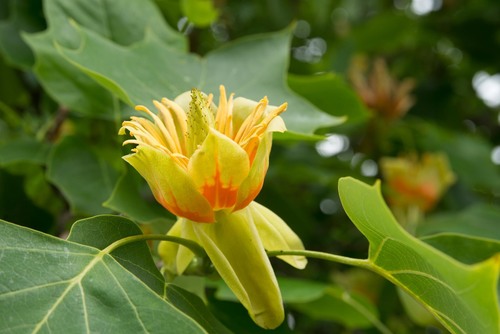
Liriodendron tulipifera
Tulip tree · also American tulip tree, Tulipwood, Tuliptree
Report an issue with this species
This tall, fast-growing deciduous tree is known for its distinctive tulip-shaped flowers that bloom in late spring and early summer, and its uniquely lobed leaves that turn vibrant yellow in fall. Its straight trunk and symmetrical crown make it a stately addition to urban landscapes, providing ample shade and attracting various pollinators and birds.
Where it grows
Trees in each city's inventory, with the share of that city's named trees this species accounts for.
- 7,7541.1%—2.4 in
- 3,8840.83%36 yr7.5 in
- 2,5110.22%—1.6 in
- 2,4591.1%—12 in
- 2,0251.0%6.9 yr8.3 in
- 1,7730.66%—2.0 in
- 1,3510.19%—8.0 in
- 1,0940.48%—11 in
- 1,0440.31%3.4 yr2.0 in
- 1,0310.56%—15 in
- 9631.3%3.8 yr2.4 in
- 7950.28%26 yr9.8 in
- 6830.58%12 yr4.0 in
- 4570.61%4.8 yr1.6 in
- 3430.77%—2.0 in
- 2660.09%—3.0 in
- 2600.74%—15 in
- 1980.15%—9.0 in
- 1770.05%—6.7 in
- 1770.38%—1.6 in
- 1550.03%3.8 yr2.6 in
- 1070.22%14 yr2.4 in
- 590.25%—9.8 in
- 540.45%6.8 yr2.0 in
- 450.29%12 yr14 in
- 320.02%1.3 yr2.0 in
- 300.04%—3.0 in
- 160.01%—5.5 in
- 20.02%—1.2 in
- 10.01%——
- 10.00%—2.0 in
Traits
- Form
- Broadleaf
- Foliage
- Deciduous
- Mature height
- 50–160 ft
- Canopy spread
- 40 ft
- Growth rate
- Fast
- Water needs
- High
- Wildlife value
- High
- Blooms
- May, Jun, Jul
Trunk diameters across every city: median 3.5 in, mean 8.0 in, 90th percentile 18 in. Measured at breast height, as published by each inventory.
Native range
Terrestrial ecoregions where this species is native. Trees in the dataset mostly stand well outside it.
Temperate Broadleaf & Mixed Forests
- Mississippi lowland forests
- New England-Acadian forests
Other Liriodendron in the catalogue
3 of the top 2,000 species are in this genus.

