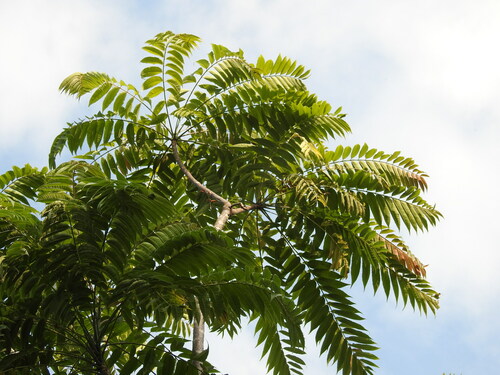
Toona sinensis
Chinese mahogany · also Chinese cedar, Chinese toon, Beef and onion plant
Report an issue with this species
This ornamental tree features a slender, upright trunk and a feathery canopy with foliage that changes color from rose-pink to deep green and then yellow. It is resilient to frost, drought, and poor soils, and is generally pest and disease-free, making it suitable for urban planting.
Where it grows
Trees in each city's inventory, with the share of that city's named trees this species accounts for.
- 8800.39%—11 in
- 330.02%—6.0 in
- 270.01%4.8 yr4.9 in
- 120.00%55 yr16 in
- 70.01%23 yr30 in
- 10.00%—24 in
- 10.00%—1.2 in
Traits
- Foliage
- Deciduous
- Mature height
- 15–25 ft
- Canopy spread
- 10 ft
- Growth rate
- Moderate
- Water needs
- Moderate
- Drought tolerance
- High
- Blooms
- Mar, Apr, May, Jun, Jul, Aug
Trunk diameters across every city: median 11 in, mean 11 in, 90th percentile 19 in. Measured at breast height, as published by each inventory.
Native range
Terrestrial ecoregions where this species is native. Trees in the dataset mostly stand well outside it.
Tropical & Subtropical Moist Broadleaf Forests
- Northern Thailand-Laos moist deciduous forests
- South China-Vietnam subtropical evergreen forests
- Sri Lanka lowland rain forests
- Sri Lanka montane rain forests
- Tenasserim-South Thailand semi-evergreen rain forests
Temperate Broadleaf & Mixed Forests
- Central China Loess Plateau mixed forests
- Northeast China Plain deciduous forests
Tropical & Subtropical Dry Broadleaf Forests
- Sri Lanka dry-zone dry evergreen forests
Tropical & Subtropical Coniferous Forests
- Northeast India-Myanmar pine forests
Montane Grasslands & Shrublands
- Southeast Tibet shrublands and meadows
Other Toona in the catalogue
2 of the top 2,000 species are in this genus.
