#597 most planted
Crataegus douglasii
Black hawthorn · also Douglas' thornapple, Columbia hawthorn, Douglas hawthorn
960
trees mapped
0.01%
of all named trees
9
cities
4.0 in
median trunk (10 cm, 892 measured)
Report an issue with this species
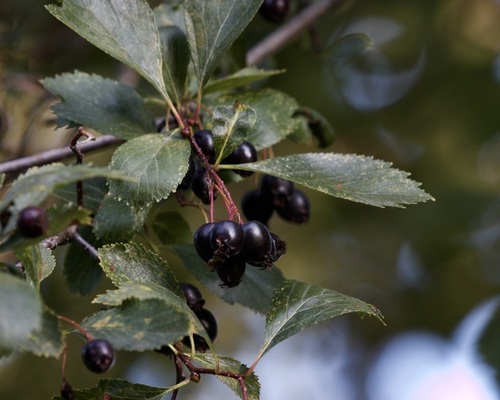
Crataegus douglasii, commonly known as black hawthorn, is a temperate North American tree species. It is most abundant in the Pacific Northwest and can be found from Alaska to the northern and western United States and Canada.
Where it grows
Trees in each city's inventory, with the share of that city's named trees this species accounts for.
- 3930.54%—5.9 in
- 2880.16%—4.0 in
- 1310.37%—1.6 in
- 900.03%—3.0 in
- 400.25%2.9 yr0.4 in
- 70.01%8.8 yr—
- 50.00%23 yr3.4 in
- 30.00%—7.5 in
- 30.00%——
Native range
Terrestrial ecoregions where this species is native. Trees in the dataset mostly stand well outside it.
Temperate Conifer Forests
- Alberta-British Columbia foothills forests
- British Columbia coastal conifer forests
- Central British Columbia Mountain forests
- Central Pacific Northwest coastal forests
- Central-Southern Cascades Forests
- Eastern Cascades forests
- North Cascades conifer forests
- Northern California coastal forests
Temperate Grasslands, Savannas & Shrublands
- California Central Valley grasslands
- Central US forest-grasslands transition
- Central Tallgrass prairie
- Montana Valley and Foothill grasslands
- Western shortgrass prairie
Temperate Broadleaf & Mixed Forests
- Eastern Canadian Forest-Boreal transition
- Eastern Great Lakes lowland forests
- Western Great Lakes forests
Tundra
- Alaska-St. Elias Range tundra
- Brooks-British Range tundra
Other Crataegus in the catalogue
29 of the top 2,000 species are in this genus.


