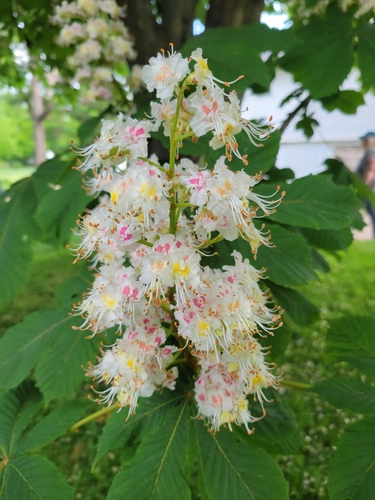
Aesculus hippocastanum
Horse chestnut · also Horse-chestnut, European horsechestnut, Buckeye
Report an issue with this species
A large, deciduous tree with a tall, rounded canopy, commonly grown in temperate regions for its attractive fall colors and dense shade. Its white flowers attract pollinators, and its seeds provide food for wildlife. It is a host tree for moths but is vulnerable to the leaf-mining moth and has mildly poisonous seeds.
Where it grows
Trees in each city's inventory, with the share of that city's named trees this species accounts for.
- 22,8092.0%—6.8 in
- 20,6999.0%—15 in
- 15,9003.6%57 yr16 in
- 3,6320.53%—4.7 in
- 3,1131.1%47 yr16 in
- 2,5611.4%—26 in
- 1,2220.17%—15 in
- 1,1400.34%5.0 yr5.9 in
- 1,0692.2%69 yr4.4 in
- 8360.31%—5.5 in
- 8192.3%—24 in
- 3160.38%—10 in
- 3030.09%—3.9 in
- 2850.39%—9.8 in
- 2820.09%—3.0 in
- 2410.32%2.8 yr6.7 in
- 2130.18%—15 in
- 1760.24%—9.3 in
- 1480.94%—24 in
- 1201.0%2.4 yr2.6 in
- 1160.26%—2.4 in
- 850.04%12 yr4.9 in
- 730.16%—10 in
- 720.05%—12 in
- 560.03%—12 in
- 500.01%4.4 yr2.4 in
- 370.31%7.8 yr4.0 in
- 110.00%—5.9 in
- 90.00%—7.9 in
- 90.02%16 yr2.0 in
- 70.09%——
- 70.01%—15 in
- 70.01%—1.9 in
- 50.02%—16 in
Traits
- Form
- Broadleaf
- Foliage
- Deciduous
- Mature height
- 50–80 ft
- Canopy spread
- 40–50 ft
- Lifespan
- 300 years
- Wildlife value
- High
- Blooms
- Mar, Apr, May
Trunk diameters across every city: median 12 in, mean 14 in, 90th percentile 27 in. Measured at breast height, as published by each inventory.
Native range
Terrestrial ecoregions where this species is native. Trees in the dataset mostly stand well outside it.
Temperate Broadleaf & Mixed Forests
- Balkan mixed forests
Other Aesculus in the catalogue
15 of the top 2,000 species are in this genus.


