Aesculus
Indian horse chestnut
Report an issue with this species
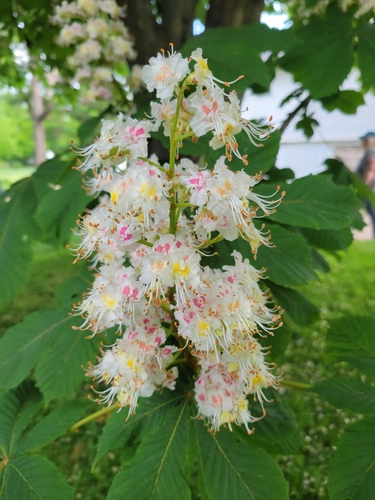
Indian Horse Chestnut is a large deciduous tree, growing 20-30m tall, with distinctive peeling grey-green bark and showy pinkish-white flowers in July. Native to the Himalayas, it thrives in moist, shady deciduous forests and is a valuable resource for pollinators. Despite its toxic seeds, it is widely cultivated as an ornamental tree in temperate regions, particularly valued for its resistance to leaf-mining moths.
Where it grows
Trees in each city's inventory, with the share of that city's named trees this species accounts for.
- 6570.29%—15 in
- 4870.04%—5.1 in
- 3200.07%4.1 yr2.4 in
- 1640.04%40 yr11 in
- 1500.31%27 yr—
- 1480.04%—9.1 in
- 670.01%—1.6 in
- 570.24%—19 in
- 440.01%5.8 yr5.9 in
- 430.03%—13 in
- 420.03%7.8 yr11 in
- 390.01%—11 in
- 220.01%—3.0 in
- 220.05%—2.0 in
- 210.01%——
- 90.01%—26 in
- 80.01%—9.8 in
- 50.00%—2.4 in
- 20.01%—7.3 in
- 20.00%—3.0 in
- 10.01%—14 in
Traits
- Form
- Broadleaf
- Foliage
- Deciduous
- Mature height
- 65.6–98.4 ft
- Wildlife value
- High
- Blooms
- Jul
Trunk diameters across every city: median 7.5 in, mean 9.8 in, 90th percentile 22 in. Measured at breast height, as published by each inventory.
Native range
Terrestrial ecoregions where this species is native. Trees in the dataset mostly stand well outside it.
Temperate Conifer Forests
- Western Himalayan subalpine conifer forests
- East Afghan montane conifer forests
Temperate Broadleaf & Mixed Forests
- Western Himalayan broadleaf forests
Other Aesculus in the catalogue
15 of the top 2,000 species are in this genus.


