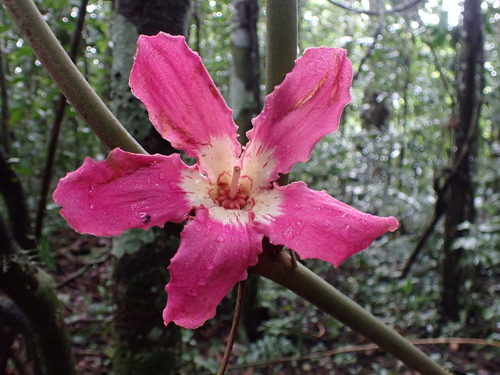
Ceiba speciosa
Floss silk tree · also Floss-silktree, Silk-floss tree, Palo borracho
Report an issue with this species
This deciduous tree, native to tropical and subtropical South America, features a thick, spiny green trunk and striking pink, hibiscus-like flowers. Its broad leaves provide ample shade, making it suitable for parks and streets. It produces cotton-like fibers from its seed pods and thrives in warm climates.
Where it grows
Trees in each city's inventory, with the share of that city's named trees this species accounts for.
- 1,6600.48%—17 in
- 5840.36%—11 in
- 940.07%—4.0 in
- 10.00%——
No city in this list records planting dates for this species, so age is blank throughout.
Traits
- Form
- Broadleaf
- Foliage
- Deciduous
- Mature height
- 40–60 ft
- Canopy spread
- 40–50 ft
- Growth rate
- Moderate
- Drought tolerance
- High
- Blooms
- Jan, Feb, Sep, Oct, Nov, Dec
Trunk diameters across every city: median 15 in, mean 16 in, 90th percentile 28 in. Measured at breast height, as published by each inventory.
Native range
Terrestrial ecoregions where this species is native. Trees in the dataset mostly stand well outside it.
Tropical & Subtropical Moist Broadleaf Forests
- Northeast Brazil restingas
- Southern Andean Yungas
Other Ceiba in the catalogue
3 of the top 2,000 species are in this genus.

