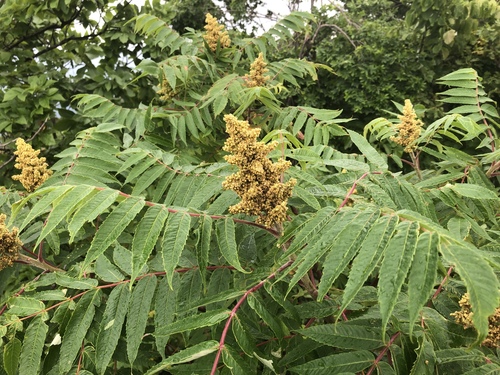
Rhus typhina
Staghorn sumac · also Stag's-horn sumach, Virginia sumac, Velvet sumac
Report an issue with this species
Staghorn sumac is known for its striking, feathery leaves that turn brilliant red in the fall and its unique, spreading form with picturesque, twisted branches. It produces clusters of greenish-yellow flowers in summer, followed by fuzzy red fruit spikes that provide winter food for wildlife. This adaptable and hardy species thrives in various soil types and requires minimal maintenance, making it suitable for city planting, though it can be invasive in some regions.
Where it grows
Trees in each city's inventory, with the share of that city's named trees this species accounts for.
- 4920.18%—2.8 in
- 3900.20%6.7 yr0.5 in
- 2760.08%—3.1 in
- 2710.02%—1.4 in
- 1800.06%—3.0 in
- 1620.05%—2.0 in
- 1600.04%26 yr7.6 in
- 800.01%—3.9 in
- 550.12%—0.4 in
- 540.05%3.9 yr0.9 in
- 480.02%—25 in
- 360.01%—5.5 in
- 320.04%—2.8 in
- 270.01%—6.0 in
- 260.01%22 yr5.9 in
- 140.01%—3.0 in
- 110.10%—3.9 in
- 60.00%—3.9 in
- 60.01%2.8 yr—
- 50.00%—5.3 in
- 20.00%—7.5 in
- 20.00%—4.7 in
- 20.00%—4.0 in
- 10.01%—7.6 in
Traits
- Form
- Spreading
- Foliage
- Deciduous
- Mature height
- 15–20 ft
- Canopy spread
- 20 ft
- Water needs
- Low
- Drought tolerance
- High
- Pollution tolerance
- High
- Wildlife value
- High
- Blooms
- Jun, Jul, Aug
Trunk diameters across every city: median 2.5 in, mean 3.6 in, 90th percentile 7.1 in. Measured at breast height, as published by each inventory.
Native range
Terrestrial ecoregions where this species is native. Trees in the dataset mostly stand well outside it.
Temperate Broadleaf & Mixed Forests
- Appalachian mixed mesophytic forests
- Appalachian Piedmont forests
- Appalachian-Blue Ridge forests
- New England-Acadian forests
Other Rhus in the catalogue
9 of the top 2,000 species are in this genus.


