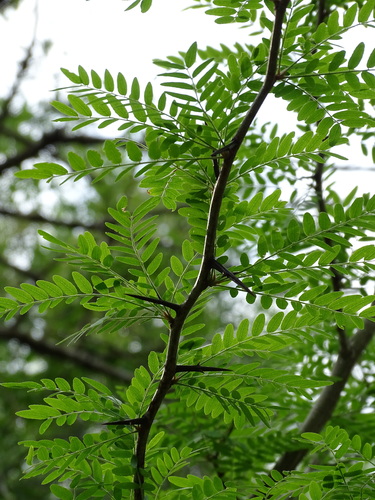
Gleditsia triacanthos
Honey locust · also Thorny locust, Thorny honeylocust, Sweet bean
Report an issue with this species
Gleditsia triacanthos, also known as honey locust, is a deciduous tree with a graceful, open canopy and delicate, feathery leaves. Native to central North America, it is highly adaptable to different environments, making it a resilient option for urban landscapes. It produces small, fragrant flowers in late spring, followed by long, twisted seed pods.
Where it grows
Trees in each city's inventory, with the share of that city's named trees this species accounts for.
- 68,2619.4%—12 in
- 59,9498.7%—7.9 in
- 31,3989.4%12 yr6.3 in
- 27,72010.2%—7.5 in
- 24,8738.1%—15 in
- 17,3415.3%—5.9 in
- 11,5139.8%—10 in
- 7,2209.6%—14 in
- 5,5733.5%5.0 yr2.0 in
- 4,0381.4%22 yr5.9 in
- 3,9750.35%—2.3 in
- 3,3697.2%—3.9 in
- 3,2691.7%6.7 yr3.0 in
- 3,1380.72%28 yr8.9 in
- 2,91712.3%—9.4 in
- 2,7266.1%—7.1 in
- 2,7113.2%—7.2 in
- 2,4151.1%—5.6 in
- 2,1371.2%—6.0 in
- 7941.1%3.8 yr1.6 in
- 5494.6%5.8 yr9.0 in
- 4970.09%—2.0 in
- 4410.09%6.2 yr2.4 in
- 3960.88%9.8 yr2.4 in
- 3810.78%7.8 yr2.4 in
- 3440.07%36 yr4.5 in
- 2302.0%2.2 yr3.9 in
- 2300.66%—2.8 in
- 1290.04%—12 in
- 1100.07%—3.8 in
- 1080.69%—9.1 in
- 840.03%—2.4 in
- 790.30%—10 in
- 740.06%—5.0 in
- 170.21%——
Traits
- Form
- Broadleaf
- Foliage
- Deciduous
- Mature height
- 35–70 ft
- Canopy spread
- 25–35 ft
- Growth rate
- Fast
- Water needs
- Moderate
- Drought tolerance
- Moderate
- Pollution tolerance
- High
- Wildlife value
- Moderate
- Blooms
- Jun, Jul, Aug
Trunk diameters across every city: median 9.0 in, mean 9.8 in, 90th percentile 19 in. Measured at breast height, as published by each inventory.
Native range
Terrestrial ecoregions where this species is native. Trees in the dataset mostly stand well outside it.
Temperate Broadleaf & Mixed Forests
- East Central Texas forests
- Northeast US Coastal forests
Temperate Grasslands, Savannas & Shrublands
- Central US forest-grasslands transition
- Central Tallgrass prairie
Other Gleditsia in the catalogue
4 of the top 2,000 species are in this genus.

