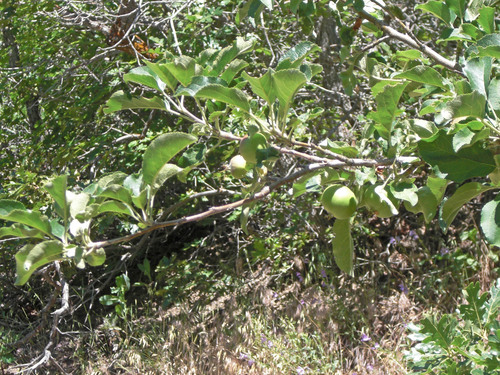
Malus domestica
Apple · also European crabapple, Common apple, Paradise crabapple
Report an issue with this species
The apple tree (Malus domestica) is known for its round, edible fruit and charming, fragrant blossoms in spring. It forms a rounded canopy, providing moderate shade, and its leaves turn yellow in autumn. Widely cultivated globally, it originated in Central Asia and thrives in well-drained soil with full sun exposure, requiring regular pruning for fruit production.
Where it grows
Trees in each city's inventory, with the share of that city's named trees this species accounts for.
- 1,2100.53%—1.8 in
- 4980.18%23 yr5.9 in
- 3320.02%——
- 2970.07%26 yr7.1 in
- 1750.24%4.8 yr2.0 in
- 1290.26%5.8 yr—
- 1280.01%—2.3 in
- 560.04%—3.8 in
- 380.02%—3.6 in
- 330.01%2.2 yr2.0 in
- 260.01%—2.0 in
- 240.07%—7.3 in
- 190.12%5.4 yr2.0 in
- 170.04%—0.4 in
- 70.00%0.6 yr1.5 in
- 20.00%—6.2 in
- 10.00%—4.0 in
Traits
- Form
- Broadleaf
- Foliage
- Deciduous
- Mature height
- 20–40 ft
- Canopy spread
- 20–25 ft
- Growth rate
- Fast
- Sun
- Full sun
- Soil
- Well-drained
- Water needs
- Moderate
- Wildlife value
- High
- Blooms
- Mar, Apr, May
Trunk diameters across every city: median 2.0 in, mean 3.2 in, 90th percentile 6.3 in. Measured at breast height, as published by each inventory.
Native range
Terrestrial ecoregions where this species is native. Trees in the dataset mostly stand well outside it.
Temperate Grasslands, Savannas & Shrublands
- Alai-Western Tian Shan steppe
- Kazakh forest steppe
Temperate Conifer Forests
- Altai montane forest and forest steppe
Deserts & Xeric Shrublands
- Registan-North Pakistan sandy desert
Other Malus in the catalogue
37 of the top 2,000 species are in this genus.


